Monday, June 26, 2017

(33) The Lazy (and frugal) Man's Guide to Navigating the Lincoln Highway

Lincoln Highway Headquarters, Franklin Grove, Illinois
June 24, 2017
The Lazy man's Guide to Navigating the Lincoln Highway

In college I majored in history and political science. I also took a smattering of philosophy courses. I guess that's why I became a lawyer, what else could I do? One of the philosophy courses that I took had as assigned reading a little book entitled: The Lazy Man's Guide to Enlightenment. I don't recall learning much from the course, and I think I even got less out of the book, but the title always stuck with me. That title came back to me today as Linda and I navigating the Lincoln Highway out of Iowa and across Illinois.

Illinois Backroads
For me, navigating an old road can be hard work. I could not do it without my wife's help. But even with Linda's able assistance, navigation has often proved a challenge. I've happened on using the GPS in such a way that it keeps me off of the interstates, and close to the alignments of Highway 30 and the Lincoln Highway. The first thing I do is set my GPS to avoid toll roads. I then plot a course from where I am (that's always a good place to start) to my next stop. Usually I don't want to travel much more than 30 to 90 miles in a segment. When I look at the course that the GPS has plotted, I find that it invariably keeps me off the interstates and usually keeps me on or very close to the Lincoln. At the times where my course deviates from the Lincoln Highway, it does not deviate much and, whats more, it follows roads that are much like what the Lincoln Highway must have looked like in the 1920's.  This "lazy man's" approach worked splendidly for us today. When we finish a segment, we plot our next stop and so on. If the
GPS is too far from where we want to go, we use the road map and the "View map" function on the GPS. 

Last night the trains returned in the middle of the night. One passed by at 2:15 AM and another at 4 AM. At least the third waited until the decent hour of 6:30 AM before deciding to wake us.

Our campsite was even prettier by morning light.

Morning on the Mississippi
Nonetheless, we enjoyed the campsite and the beautiful scenery. The Mississippi in the morning was a sight to behold. While I could have done without some of the bugs, that was a small price to pay.

We had breakfast at a café in Clinton, Iowa. It seemed to be a place where the locals congregate and we were soon recognized as outsiders. This is not a bad thing in the Midwest, because Midwesterners are very welcoming and immediately wanted to know where we were from and where we were going and how they could help.

I struck up a conversation with Wayne at the next table. Wayne told me how his grandfather had traveled the Lincoln in a Model T and by camping. When Wayne learned that Linda and I had started out from California, and in particular that we had spent the night at Donner Lake, he told me that he had been to Truckee, California the year before for a class reunion. I asked Wayne what kind of class reunion this was and where he went to school?
Wayne and I after breakfast
I was surprised when Wayne told me that it was a high school reunion and that he had gone to a small high school near Clinton. apparently, there are less than a dozen people in Wayne's class, including 1 from Truckee. The classmate from Truckee raised the point that he was always travelling to Iowa, and that perhaps it was time the others travelled to California. All agreed and the next reunion was held in Truckee.

I was even more surprised when Wayne told me that when he was in California he met a gregarious gentleman at Donner Summit who noticed his Lincoln Highway hat. The man then gave Wayne a gift that would go with his hat. This piqued my curiosity so I asked a couple of more questions and was surprised to learn that the gregarious gentleman at Donner Summit was my old friend Norm Saylor. It is a small world.

Linda considering trading the old 
rooster in for a newer model
Courthouse in Clinton, Iowa
After breakfast, Linda and I stopped at a couple more places in Clinton to take photographs. I'm impressed by the substantial nature of these Midwestern towns. Everything is built to last and in most cases it has lasted.
Iowa in the rearview mirror


Next came the moment I had been waiting for, crossing the mighty Mississippi. I drove and Linda took pictures. It was a crisp clear morning and a view from the bridge was stunning. What a great country this is!
Mississippi, from the Bridge


Am I excited, or what?


Fulton

Our first city in Illinois was Fulton. We stopped at the visitor center in Fulton, which was a beautiful windmill. It is an accurate reproduction of German and Dutch windmills of the eighteenth and nineteenth century.
Beautiful!
Dixon


Dixon Postcard


From Fulton it was on to Dixon, the hometown of President Ronald Wilson Reagan. 
Reagan's boyhood home
 The visitor center was closed, but it was fun to poke around the exterior bit. I read once that President Reagan worked as a lifeguard at a beach along the Rock River. The story I read credited him with saving 70 lives. I was always a bit skeptical of the story and thought maybe it was an exaggeration for political purposes. However, when I saw the Rock River, I can now see that there is a likelihood that there is more truth than exaggeration in the story. The Rock is a fast-moving and dangerous looking River. At least the part of it that flows through Dixon.

After we finished looking at the Reagan sites, we drove down to the river to pay a visit to another Lincoln statue. The statue was of young Abe at the time he served in the Black Hawk war.
A young Abe, ready to serve
It's hard to imagine that less than two hundred years ago this populated area was rugged frontier.
Before leaving Dixon, we passed under the Dixon arch. Many towns featured arches above the Lincoln Highway or other prominent highways. It's nice that the Dixon arch has survived, as has Reno arch and some others.
Dixon Arch
Franklin Grove


Franklin Grove Postcard

After Dixon it was on to Franklin Grove and a visit to the Lincoln Highway headquarters. I was able to get away with buying two more books. One on the Lincoln Highway in Pennsylvania and another on Carl Fisher. Linda is getting tired of books on Highway history and automobiles.

Rochelle, Aurora
Restored Gas Station serving as a visitors center in Rochelle, Ill.
From Franklin Grove we moved on to Rochelle, Illinois. There we viewed a 1919 gas station. After Rochelle we proceeded towards the city of Aurora, travelling through DeKalb. DeKalb features 1 of only 6 theatres named "Egyptian", since 1 of the other 6 is in our hometown of Boise, we needed to take a look. It was worth the stop.
DeKalb's Egyptian
Boise's Egyptian


Along the way we viewed additional Lincoln Highway murals. My friend Bob Cooper is from Aurora and he has always spoken glowingly of his hometown. I'm happy to report that there is no exaggeration of the city or its buildings.

Aurora's Stone CB&Q Roundhouse
We viewed a stone Roundhouse of the CB&Q Railroad which has been restored and has a number of businesses in. Unfortunately the information center did not have any maps showing us the way to Bob's boyhood home.
Paramount Theatre in Downtown Aurora
We next traveled to Joliet Illinois and saw the point at which the Lincoln Highway and Route 66 cross. Lincoln Highway aficionados can get sensitive about Route 66 because it has a catchier song, a television series and consequently has a greater presence in the popular psyche. When my brother-in-law heard that I was traveling across country he assumed that I would be traveling on Route 66.

Hi Mike!

He is very generous and bought me a commemorative silver coin to carry for luck. I carried the coin, and mostly it has brought the luck, and finally today I was able to finally get a picture of it in an appropriate setting.


Intersection of Lincoln and Dixie Highways
in Chicago Heights, Ill.
We traveled through Chicago Heights before crossing into Indiana. At Chicago Heights we saw the point at which the Lincoln Highway and the Dixie Highway cross. The Dixie Highway was another inspired idea from Carl Fisher. It provided a road for snowbirds to use in traveling from the Midwest to Miami Beach, which incidentally, is another inspired idea of Carl Fisher's.
Ideal Section, the original
"Demonstration Project."


After crossing into Indiana I was happy that we were able to find, locate and stop at the Henry Osterman Memorial. Henry Osterman was the field secretary for the Lincoln Highway Association, later he became Vice President of the Lincoln Highway, Association. It was Henry Osterman, more than anyone in persuaded the Army to demonstrate its ability to move men, and equipment from the East Coast to the West Coast motor transport. 

Osterman was a relatively young man at the time of his death. He had just married a young wife, who became a young widow. He dedicated his life to the highway and it is a shame that he lost it on the road that he loved.

Osterman Memorial on busy Hwy. 30 in Dyer Indiana
We covered less than 200 miles today but there was much to see and it was a long day. Because we are tired were going to cheat a bit tonight and stay in a motel. I hope are not developing a bad habit.


Sunday, June 25, 2017

(32) On the Banks of the Mighty Mississippi


View from our Campsite
Camping On The Banks of the Mississippi

We are camping tonight on the banks of the Mighty Mississippi River. We are at a campground maintained Army Corps of Engineers the widest point of the Mississippi. I have only ever seen the Mississippi from the air, so this is quite a thrill for me. Tara and Dave, two campers we met as they were gathering wood for a fire told us that two or three weeks ago our campsite was underwater.
Camping neighbors Tara and Dave
They also told us that this is the widest point on the Mississippi. The threat of flooding is long since passed and we thought we had the perfect campsite, then the train went by. It is very close to the campsite and I'm hoping that it will be the last one tonight.

This campground is more like the ones that Linda and I remember. Most of the people we encountered are talkative like Tara and Dave. All of the people we've met on this trip in campgrounds have been friendly, but this campground is a bit more social. Many of the other campgrounds are filled with large trailers and RVs which are self-contained and featured such amenities as satellite TV. Rather than having a campfire the owners of those RVs retire to the interior and watch satellite television. It's a great way to see the country, and sometimes I have to admit to feeling a little bit of jealousy. But... I don't think it's for me.

We left Denison this morning before seven thirty. We had dinner on the road and arrived here to set up camp. It was a long and eventful day, but a pleasant one.

We didn't attend the Lincoln Highway Association's annual membership meeting this morning as we wanted to get on the road moving east. We said our goodbyes last night at the banquet in this morning as we left the motel. This is our second Lincoln Highway conference we are beginning to get to know some of the people. I can see why many say that these conferences are a bit like family reunions. We enjoyed our time at the conference very much. I think the lesson to take from this meeting is that the old highways connected people. And in the case of the Lincoln Highway Association and the Yellowstone Trail Association as well as some of the other named highway associations, they are still connecting people.

We're continuing to travel on Highway 30 and avoiding the interstate. I'm finding myself a little more relaxed traveling like this. It is certainly more enjoyable. Our first stop after leaving Denison for the towns of West side and Carroll.
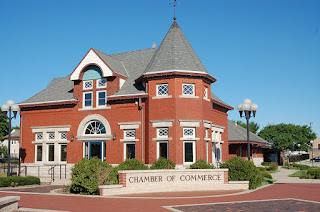
Chicago and Northwestern Depot

We stopped at those towns even though I saw them on one of the bus tours. Unfortunately the bus didn't stop the beautiful Chicago and Northwestern train station. So on the way out of town, I made a point to stop and take a picture of it. The bus tours were great, but for someone like me that needs photographs to help remember places we weren't given a lot of opportunity to take pictures. Trying to take a picture from a moving bus is difficult at best.

Traveling along Highway 30 I was able to see even more clearly one of the things pointed out during the bus tour. That was the fact that the original alignment of the Lincoln Highway followed section lines. The original Lincoln Highway was laid out on either a north-south or an east west line. This allowed utilization of section lines and did not require the condemnation of land. Of course, the right-of-way provided in the section lines was not adequate for automobiles. This soon became clear as did the danger of having a 90° turn every mile or quarter-mile. The later alignments of the Lincoln Highway and Highway 30 used eminent domain to condemn land so that the highway could run diagonally across the sections.

Iowa Scenic Byway Marker
The state of Iowa has done a wonderful job of signing the Lincoln Highway By Way. Not only was Highway 30 marked as part of that Byway, but the old alignments which are usually gravel roads are also marked and signed. A driver can decide whether to follow the original alignments or the more modern alignment of Highway 30. Watching for the marked signs and using the map on my GPS gave me a very clear picture of how the old road would cross and re-cross Highway thirty. (Can you say distracted driver.)

Birthplace of Mamie Eisenhower

In Boone, Iowa we stopped to see the birthplace of Mamie Eisenhower. It was a modest home and was furnished in either the original furnishings or correct furnishings. The docent, Dorothy was very knowledgeable about the house, about Boone and about the Doud family. Dorothy knew many of Mamie's relatives and can recall seeing Mamie Eisenhower in town with her Secret Service protection. In the garage was an old Chrysler Windsor which the Eisenhower's had purchased for Mamie's uncle.
There was also a 1960s Plymouth which was Mamie's car and was later given to her grandson and his wife, David and Julie Eisenhower.


Boone was an important town for Mamie and for President Eisenhower. Eisenhower announced that he was a candidate for President from the park in Boone. Mamie came home to Boone many times. It was a delightful visit made all the better by the passion and professionalism of Dorothy who is a retired fifth grade teacher.

Dorothy our knowledgeable tour guide
Room where Mamie was born
Niland's Corner


Colo Motel at Niland's corner
Colo Motel today
From Boone we took old Highway thirty, the Lincoln Highway, to Niland's corner, where the Lincoln Highway intersects the Jefferson Highway. The Jefferson Highway, like the Lincoln crossed America but unlike the Lincoln it did so from north to south or as a people in New Orleans might say from south to north.


That highway started in New Orleans and ended in Winnipeg Canada. Niland's corner was historic and significant in it's nice to see it so well restored. Linda and I took ample time to walk around the buildings before entering the café.
Highway Pole markers
for Jefferson and
Lincoln Highways


Display in Niland's
The café is restored and at one end features historic displays. They also serve great food and provide super service. In Niland's we had lunch with Lyle Henry and Wayne Shannon of the Lincoln Highway Association. Between the business meeting not going as long as I thought it would and our side trips and sightseeing they were able to catch up to us.

Chewing the fat at Niland's 
Lyle and Wayne at Niland's
I enjoyed talking with them as they are both well versed in the history of the Lincoln Highway and other old highways. Lyle was one of the speakers at the conference, has written a book on the Jefferson Highway. I enjoyed talking with him as I did my conversations with Wayne.

From Colo we proceeded to Tama, Iowa. Tama also has some old Lincoln Highway sites.
Lincoln Highway Bridge at Tama
Chief among these is the Tama Bridge. It was built in 1925 by the city of Tama and is a source of pride to that community. It is the most well-recognized bridge on the entire Lincoln Highway. East of the bridge is a tower café and service station.
Builder's Plate for Tama Bridge


Tower Café in Tama


Our next stop was Belle Plaine, Iowa where we stopped to see the Preston service station and the Herring hotel.
Preston's Service Station

The Herring hotel was recognized as providing first class accommodations in a small town atmosphere. In its day it was called "The Swellest Little Hotel in Iowa."
Herring Hotel may yet see better days again


Among its guests were Mark Twain and President Theodore Roosevelt. Unfortunately, the Herring hotel has suffered a long period of neglect. However, it looks like things are due to turn around. Volunteer labor has worked to stabilize parts of the hotel and the owners are working to secure grants to restore the Herring to its 1922 condition and appearance. Yesterday we had a presentation on the efforts to preserve the Herring hotel.

We also stopped to see the tower café and service station as well as the Youngsville station.

Lincoln Café across from Herring Hotel


Rush Hour in Belle Plain


Youngville


I went out to take pictures of the mighty Mississippi this evening. Some of them appear with this entry. When I returned to the tent trailer I was surprised to see that Linda had added twinkly lights to the ceiling.
Twinkly Lights

It looked nice, but I can see that she's just not going to get this "Glamping" idea out of her system.

Tomorrow we'll spend a little bit of time exploring Clinton Iowa and then we will cross the river into Illinois. I have to admit to some excited anticipation at the thought of driving across the mighty Mississippi.


Friday, June 23, 2017

(31) Lincoln Highway Conference

Friday, June 23, 2017

Songs of the Road
Friday, June 23, I spent at the conference listening to speakers provide information about the Lincoln Highway and its history. While I was having fun, Linda spent the day getting us organized for the second half of the trip. We are going to drive on to New York and explore the rest of the highway. I guess you could say I finally talked Linda into going all the way.

We hope to get to New York City by July 1 and then drive north to Plymouth Rock where we will start our trip west on the Yellowstone Trail. Because we have so far to drive we will skip the closing breakfast and meeting in order to begin our drive east.

The conference topics were quite interesting. The folks from Iowa who organized and put on this conference did an exceptional job. I'm sorry that we have to skip town so early.

Kay Shelton, President of the Lincoln Highway Assn. presented an interesting topic on the women of the Lincoln Highway who had crossed the continent in the early days of motoring. Of course she discussed Emily Post, but she also discussed my favorite Effie Price Gladding. Effie and her husband more or less drove the entire Lincoln Highway. It's always irked me just a bit that Emily Post talked so disparagingly of the Lincoln Highway and seemed to find another route whenever she experienced any serious difficulty. Of course, in a early days of motoring there were always serious difficulties.

Kay also discussed three young girls who would take summer vacation motoring trips In an old Model T and seemed to have a great deal of fun. The young women even managed to insinuate their way into meeting Henry Ford and attending his birthday party.

We also heard from Christine Pope who, is restoring the Herring Hotel in Belle Plaines, Iowa It's a huge project and they are restoring it to how it looked in the early to mid 1920s. I wish them luck.


Finally, Lyle Henry finished the morning by informing us of some of the unusual ways people got to the 1915 Panama Pacific International Exhibition. There were actually quite a number of unusual means of getting to the 1915 fair. These unusual means included a dog team, motorbikes, push mobiles, a wheelchair and walking backwards. Much of this was caused by a rumor that a large monetary prize would be offered to the individual who arrived at the fair in the most unusual fashion.


The afternoon presentations were not only informative, but entertaining. Cece Otto returned and spoke to us about "Creating an American Song Line". As I've said before, Cece is really quite talented and after she finished her talk she treated us to more old songs. It was not only a musical experience, but an interactive history experience as well.


Thursday, June 22, 2017

(30) America's Hometown Produced America's Sweetheart


Lincoln Highway, "The Main Street of America"


Tuesday June 20 - Thursday June 22


I have decided that I like the Midwest very much. While I had expected a dull monotonous landscape I found my surroundings to be very pleasing. Particularly here in Western Iowa. The countryside here resembles Palouse country of Western Idaho and Eastern Washington.

Loess Hills of Western Iowa, with
Terraces to prevent erosion.

The rolling hills of both regions are covered with  green crops produced by a rich soil that is fertile and produces outstanding crops. In the case of the Palouse it is Wheat. Here, in Iowa it is corn and soybeans.

The Midwest was formed by the the great ice sheets that covered North America during successive ice ages. The ice leveled everything in its path and ground rocks to dust. In the case of Western Iowa this dust is blown and deposited onto the rolling hills. It is called loess. Soils of the Palouse were deposited there when the dam in Lake Missoula broke. This also occurred during an Ice Age. The resulting flood scoured the scab lands in Washington, but deposited much of the rich soil into the region of the Palouse. Soils are different and the formation of the land was different but the result appears to be much the same. Rich fertile farmland which produces abundant crops and the basis of a way of life for a hard working people.

Farm in Western Iowa

Lincoln Highway Conference in America's Heartland

CeCe Otto Sings for the opening reception of the 
Lincoln Highway Association


We are in Denison, Iowa for the twenty-fifth annual Lincoln Highway Conference. This is a gathering of road enthusiasts. The Modern Lincoln Highway Association was formed to foster the preservation of the Lincoln Highway, its history and structures along Highway. I think their efforts have met with success.

To most people attending a conference of road enthusiasts would be incredibly boring. To me it is not. I am interested in history and transportation history. I also find that joining special interest clubs, like the Lincoln Highway Association, provides me an opportunity to meet a cross-section of people which I might not ordinarily have the opportunity to meet and that would have been my great loss. I've  found that I have much more in common with these folks than simply transportation history or the love of old pavement.

Tuesday evening was the opening gathering of the conference. I met CeCe Otto who has a beautiful voice and was trained in classical opera. She branched out from Opera into singing songs of the early twentieth century. In particular she likes songs about World War I, the Lincoln Highway and other popular songs of the 1910's and the 1920's. She is enthusiastic about her art and that comes across.
The opening gathering was also brought to life by Warren and Elizabeth from Austin, Nevada.
Warren was dressed as a World War I doughboy and Elizabeth as a World War I nurse. Elizabeth is an expert in vintage clothing, which she collects, displays and on special occasions even wears. (A special occasion is every opportunity she and Warren have.)

"In my medical opinion Linda, your husband needs help."

Touring Western Iowa

Hon. Daniel Leinen,
Mayor of Denison, Iowa
My conclusion that Iowa, like Nebraska, has firmly embraced the Lincoln Highway was reinforced Tuesday night. The mayor of Denison addressed the gathering, as did the head of the local Chamber of Commerce. The mayor read a proclamation which had been passed by the City Council.

Vintage Service Station, Western Iowa

Wednesday morning the conference featured a bus tour east of Denison. The buses traveled on the original Lincoln Highway even in cases where the original Lincoln Highway had been superseded by later alignments and by US Highway 30. For much of the morning we found ourselves on gravel roads. While I don't generally prefer gravel roads I found that with a little or maybe more than a little bit of imagination, one could gain a feeling what navigating these roads must been like at the beginning of the twentieth century.


Mahanay Bell Tower and Lincoln Statue
Jefferson, Iowa
We stopped for Lunch in Jefferson, Iowa. The centerpiece of Jefferson is the Mahanay bell tower which is 168 feet tall and features a carillon. 

View from Mahanay Bell Tower
The view was spectacular. The area around Jefferson is much flatter than the terrain around Denison. Consequently we had an unobstructed view of the city and the surrounding countryside.

J.E. Moss was a Civil War veteran who had been decorated by President Lincoln. Moss was a great admirer of Lincoln and had Busts of Lincoln erected adjacent to his property on the Lincoln Highway to honor the fallen president.


Moss Lincoln Bust near Scranton Iowa
Thomas Jefferson finds a quiet place to 
proof the Declaration in Jefferson, Iowa


On Thursday the bus tour continue traveling west of Denison, to Council Bluffs Iowa and into Nebraska visiting Omaha and Elkhart.

Union Pacific Museum in Council Bluffs Iowa
In Council Bluffs we visited the Union Pacific Museum and in Omaha we saw a number of sites. Once again we spent some time on the gravel roads and even on a long section of brick road. On the way we were also "treated" to travel on what are called the stair steps. The stair steps result from roads following section lines. I believe that farmers property adjacent to section lines were required to provide right-of-way along the section lines. While the state has had the authority to condemn land from roads would cut across farmers' property, that would be expensive. As a result of not wanting to condemn land motorist were treated to a sharp 90° curve every quarter-mile or mile or so. Modern Highway thirty cuts from the Southwest to the Northwest crossing Southwest Iowa. Originally Lincoln Highway roads in the Midwest either went east-west or north-south with a sharp turn every quarter-mile or mile or so. This was dangerous even with cars not capable of the high speeds are automobiles today.


Donna Reed
Linda reflecting on her Wonderful Life and hoping George 
Bailey will stop in. "Hot Dog!"


Tuesday night we went to the barbecue with the other members of the Lincoln Highway Association, held at the Crawford County Fairgrounds. After dinner we went to downtown Denison to the Donna Reed Museum. Donna Reed is the crown princess of Denison. Although Donna became a famous actress of movies and television in the 1940's through the 1960's, apparently she never forgot her roots. Much of the appeal that she had in Hollywood is based upon values that she took with from Denison.

The Donna Reed Museum features a soda similar to the one in "It's a Wonderful Life". As you can see from the picture, Donna still looks great and she was agreeable to having her picture taken with me. I was surprised how short she was. I felt just like Jimmy Stewart.

Me with Donna Reed


Tomorrow I'll attend some presentations on Lincoln Highway history. Between my time here in Denison and my time in the counties north I will certainly take with me fond memories of Western Iowa.

1916 Buick. Unrestored and still running.