Wednesday, April 26, 2017

(19) So it begins: San Francisco to Donner Lake

Day 1, June 9, 2017
Out of the City and under the Bay


Postcard showing Golden Gate and San Francisco-Oakland Bay Bridges as
well as Treasure Island, site of 1938 World's Fair

It was with both a great sense of relief and apprehension that we left San Ramon in the late morning of June 9. Relief because the ordeal we experienced is now over. A little apprehension over what might lie ahead if our bad luck should continue.

From San Ramon we traveled south to Interstate 580. There we pointed the car east to Livermore. In Livermore we stopped for pictures of a restored service station
and also to look at the Duarte Garage which has been restored and is maintained by the Livermore Heritage Guild.
Duarte Garage, Livermore, Ca.


We then took the old Altamont Pass Road to Tracy. This is one of my favorite stretches of the trip. The road and the terrain remind me much of what the road must have looked like during the heyday of the Lincoln Highway. We stopped at the Summit Garage for another picture.
Summit Garage, Altamont, Ca.

Me in front of historic building in Banta, Ca.  
In Tracy we stopped to snap a couple of pictures as well. Then we headed north to Sacramento and Interstate 80. Interstate 80 will take us to Soda Springs and Donner Lake where we will spend a couple of days regrouping and transferring our gear into the 2006 Mustang. Of course, some things will have to be left behind and we will have to consolidate our baggage. From there it was north to Sacramento. Since I had just traveled this route in September, we didn't stop for more than just a couple of photos.
Building In Banta, Ca. Historic photo from Tracy Historical Society

Banta Inn, near Tracey, Ca.


Western Terminus of Lincoln High. from American Heritage
magazine, Vol. 25, No. 4, June 1974
Before Interstate 80

At Sacramento, we picked up highway 80 and began the climb into the Sierras. Before Interstate 80, the trip from our house in the Bay Area to our cabin at Donner Lake could be long and hot. But hey, I was a kid and what was miserable to my parents was an adventure for me. By the time I was 6 or 7 the freeway had swallowed up most of Highway 40. Dad was excited about the time saved, but I have to admit in my young consciousness I missed the rare stops at the "Giant Orange" in the Valley, getting doughnuts in Sacramento for Saturday morning breakfast or Mom dispensing  rations of lemonade from

Giant Orange Juice stands. The one on the right, although way before my time, is closer to those I remember. Internet photos, (the one on the right was apparently from the Tracey Historical Society)
the "Little Brown Jug". The small cups of lemonade were passed back through the station wagon to my brothers and me. They were never big enough.

Little Brown Jug
Any interruption in the trip was, of course, and aggravation for Dad, but was added interest for me. I loved the smell of the Presto Log mill just west of Sacramento and on one very rare occasion being held up by the open drawbridge over the Sacramento River. Overall, my memories of these trips are dim yet parts are vivid and intense. One thing that I can remember about the trips was that they were long and hot. The heat began in Sacramento and rose steadily until Auburn.

The heat would finally break around Emigrant Gap and by the time we got to Cisco Grove and Soda Springs the air was cool and pleasant. Even as a youngster I remember looking at the cabins and lodges along the Yuba River and thinking how inviting they looked.

Cabin along the rushing Yuba River

Entry to Rainbow Lodge

Forest Gift Shop, Popular before I-80 (On the way to San Francisco)
Rainbow Lodge was and still is beautiful. A few years ago Linda and I had breakfast at the rainbow Lodge. It was like entering a time capsule.

Ranchero in front of Rainbow Lodge, on the way to San Francisco


Soda Springs to Donner Lake
Norm Saylor out side his museum, Soda Springs, Ca.

At Soda Springs we came upon Lake Van Norden just south of the highway. Sadly, the beautiful Lake is gone, having been drained for some reason or other. With the lake drained, the micro-climate it created also disappeared. Nothing left but a memory of the beautiful scene.

East of Soda Springs came the ski resorts and utilitarian railroad structures. In the late 30's Skiers arrived via "The snowball Express". Later they came by car.
Our son, Will, sits atop Lincoln Highway
Subway 1994

The China wall


At the summit is tunnel number 6 of  the Central Pacific Railroad.                                                                                                            
Vertical shaft drilled into the middle of Tunnel number 6 to allow the 
Chinese crews to work 4 faces of the tunnel instead of just 2.
A miracle of engineering and tenacity. A tribute to the labors of the Chinese crews and the genius of the railroad engineers who designed this segment of the transcontinental railroad. Much of the rock that was taken from tunnel number 6 was used to construct The China Wall which can be seen just east of the "subway" (underpass) of the early alignment of the Lincoln Highway over Donner Summit.
On the left side of this photo, the 1914 underpass can be seen. On the right is 
the original crossing which used the Dutch Flat-Donner Lake Wagon Road
and made a dangerous crossing through the timber snow sheds.
Before this subway, automobiles passed through the train sheds. At best crossing the tracks through the train sheds was dangerous, at worst it was deadly.

An early crossing through the sheds, The car to the right didn't
make it. (Photo from book "Donner Pass" by John Signor) (This
photo is not of the Donner Summit Crossing.)

Donner Summit claimed a lot of trucks and cars on its curvy downgrade. Many of these wrecks are still visible despite the passage of more than 50 years. A couple of years ago my son Will and I came across the carcass of a 1950 Pontiac. Norm Saylor tells a hilarious story of scavengers picking through a refrigerator truck full of frozen turkeys bound for Thanksgiving tables at Stead Air Force Base near Reno. The FBI rounded up the missing turkeys and admonished the scavengers.

Post Card of Summit Bridge immediately after construction
The overlook at summit bridge puts on a display of the entire history of transportation over the Sierras. Most obvious are the recent additions. Looking east one can see off to the left Interstate 80. Of course, the overlook is part of U.S. 40. Off to the right is the original Transcontinental Railroad. Looking to the south one can see the Lincoln Highway subway, or underpass assuring at least one safe crossing of the mainline. Just west of the subway one can see the Dutch Flat - Donner Lake Wagon Road which served for a year as the Lincoln Highway and crossed the tracks through the Timber Snow Sheds. The road was also the route by which construction materials were brought to build the railroad. Here more than anyplace else one can see that our highways do not simply spring forth from the wilderness, they evolve and build upon what came before.


Somewhat later, the road is paved

When the freeway opened, travel time from Walnut Creek in the bay area to Donner Lake was reduced from the 4 to 6 hour drive to less than 3 hours. Population growth and the attendant traffic has raised travel time back from 3 hours to nearly the 4 to 6 hours that it was in 1960. I feel sorry for travelers making the trip now who won't find a "Giant Orange" at which to quench their thirst and will have to settle for the closest McDonald's at the end of some non descript freeway off ramp.

Original Bronze Plaque for Summit Bridge

Lincoln Highway 1913 alignment, Sheds can be seen to the right
(Stereoscope card)
Whitney Hotel advertisement on rock along 1913 alignment.
The sign reads: "We invite inspection"

Reproduction 1928 marker along Donner Pass


Saturday, April 15, 2017

(10) Preparations, Sea Trials PART I

(1) A Ford Amongst The Packards


Palace of the Legion of Honor
Lincoln Park, San Francisco

Before setting off on this cross-country trek I decided it would be best to make a couple of trial runs. As much as I'd like to believe that "failure is not an option," it is certainly a potential outcome. But a little bit of practice can minimize the chance of failure and help in anticipating the challenges of the road. Practice may not be as important as vehicle preparation, but it will help in anticipating problems.


Ready to go
"Wait, Just 1 more picture"
For the first trial run I decided to do a tour with a group. Last September the San Diego Packard club and the California Lincoln Highway Association sponsored a tour of the Lincoln Highway in California. California is the one place that has had, since the inception of the Lincoln Highway, two routes. One route travels west from Reno, over Donner Summit and down to Sacramento. The second route travels the South Shore of Lake Tahoe and runs down what is now Highway 50. This one is often referred to as the "Pioneer Route". In all other cases it was the goal of the association to find the single most efficient route.

After leaving Lincoln Park in San Francisco, our first stop was at the Blackhawk Automobile museum in Danville in the East Bay from there we travelled to Livermore, then over Altamont Pass to Tracey. Then it was North to Stockton and Sacramento.


Western Terminus, Lincoln Highway Lincoln Park, San Francisco


Blackhawk Auto Museum, Danville, Ca

Summit Garage, Altamont, Ca

After spending the night in Sacramento, we climbed into the Sierras through Placerville and over Echo Summit, then on to Reno. The San Diego Packard Club is really a great group to tour with. They were very welcoming and didn't mind at all having an old Ford with its sometimes grumpy owner joing them. Having been to a lot of car shows where there are a lot of "trailer queens" it was nice to see people actually using their cars for an extended road trip. If I had any questions about the cars or the tour I knew that I could simply "ask the man who owns one."

Kyburz, Ca. Pioneer Route, Lincoln Highway
No one is really quite sure why there are two Lincoln Highway routes across the Sierras to Sacramento. Some say that Henry Joy, Lincoln Highway Association president, was really taken by the beauty of South Lake Tahoe and the road that would become the highway 50 corridor. My own theory is that two routes were provided because of the notorious reputation of the passes into California. When the Lincoln Highway was created, it was less than 70 years since the Donner tragedy. Even now, with modern snow removal equipment, Donner Pass is often closed by bad weather. Whatever the reason, the fact that there were two routes over the mountains meant we were able to see some beautiful scenery, but not have to back track. There are other places along The Highway where there are two routes, however these other spots are usually result of later alignments finding a more efficient route.

Echo Summit
I'm glad that I took this first trial run with a group tour. I learned some important lessons which will help on the cross country trip. I also learned some things about myself. One thing that I learned was that although I was raised in the San Francisco Bay area I really have no tolerance for heavy traffic or crowded roads. At one point I even made the snide comment that the tour should be called: "The Northern California Traffic Tour". Even US Highway 99, north of Stockton, was at times backed up. I am amazed that there are people who voluntarily subject themselves to this on a daily basis. Oh well, to each his own.

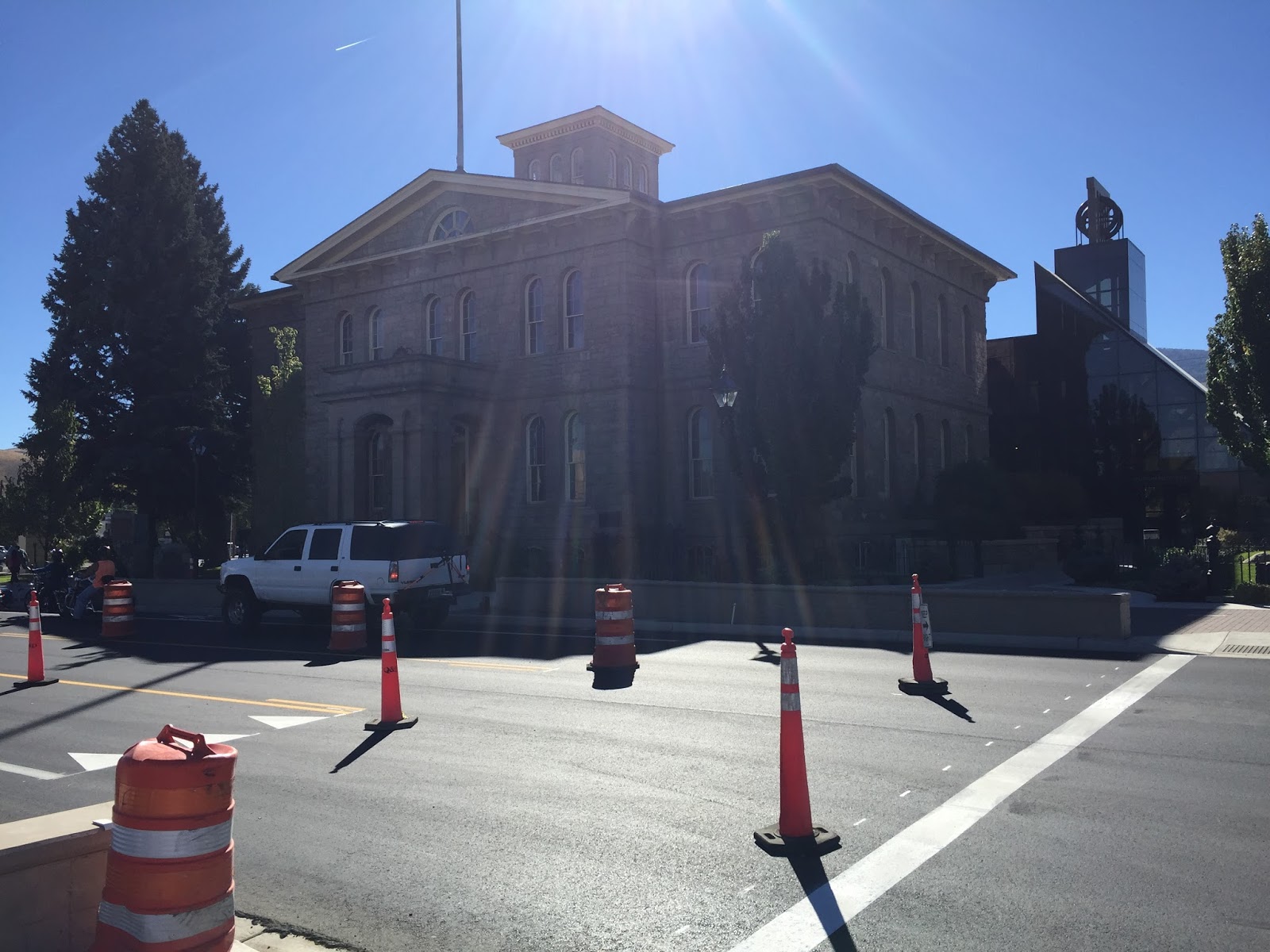
Carson City Mint, Sept. 24, 2016 We missed a ceremony held
earlier in the day observing the 150th anniversary of the setting
of the cornerstone. (Traffic cones are a later addition)
Another thing I learned was that I took the wrong car. Believe it or not I own two old Rancheros one is a 1959 that Linda and I will be driving east across America. The other Ranchero is a 1967 that my parents bought new. It is not as nice of a travel car as the 1959. The 1967 is a stripped down, basic 6 cylinder, while the 1959 has a big engine, is better insulated and has air-conditioning so that the windows can be rolled up on hot days while traveling on a crowded freeway. The crowded freeway in the hot noisy car also contributed to my ill temper. I had originally planned to take the '59, but I was still working out some issues from the rebuild. The 1967 was a sure thing. On a positive note I averaged over 20 miles to the gallon on the tour.

Nevada's grand old Statehouse


Ultimately my dislike of the heavy traffic of California urban areas caused me to leave the tour before I reached Sacramento on the return trip. I have to say there were a couple of things unique to California driving that contributed to my aggravation. One occurred after the Banquet at the Auto Museum in Reno. I had decided to drive to the cabin at Donner Lake to spend the night. No need to run up and expensive motel bill when I had a comfortable bed and more pleasant surroundings just 35 miles west of Reno. Unfortunately, I failed to take into account that Highway 80 would be closed that night. It was not closed for snow or weather, rather it was closed for a gang shooting that was taking place at the agricultural inspection station just east of Truckee. Shootings in the Sierras and in Reno are not necessarily uncommon occurrences in September. They often coincide with a Reno motorcycle event called "Thunder in the Streets" or something like that. What amazed me the most was that nobody seem to be making a big deal out of the fact that a major interstate east-west highway was closed for an active shooting. Apparently, it was just a recreational shooting. No need for alarm. The folks in Reno were just happy that the bikers had chosen to leave the city before drawing their guns. The year before the guns were drawn and the shots were fired inside of a casino in downtown Sparks.

Lincoln Highway along Donner Lake
After a partial night's sleep at Donner I joined up with the tour participants again at the Donner Memorial State Park. There, we had a tour by docent Greg Palmer. Following the tour we were also able to tour the museum at the State Park. The Donner Party tragedy is hard to comprehend. While some say the emigrants brought it on themselves by a late start, incompetence and poor leadership I find myself thinking that they were not that far out of the norm of 19th century farmers. They were in a difficult situation, they were late, they had taken a route that was untried and untested based on advice from a 19th century con artist and the snows came just a little early that year. Add to the mixture stress and short tempers it becomes easy to see how circumstances overwhelmed them.

Neil Rodrigues, Vice President, Ca. Chapter, LHA

I stayed with the tour down the western slopes of the Sierras and then as the afternoon temperatures climbed and the traffic increased I decided to peel off and return to Donner. All in all I enjoyed the tour and I'm glad that I did it. One of the chief things I learned was that my road atlases were not going to be sufficient. They required me to take my eyes off the road too often and to recall the details of the comprehensive driving instructions more often than I wanted to do. I had begun to consider a GPS even before I did this tour. I was told to save my money and to simply use my smart phone. I found out very quickly that the smart phone is inadequate for this type of touring. If you don't have a GPS that can sit on the dashboard so that you don't have to take your eyes very far off the road then you need a navigator who will be happy to hear you recount the details of the tour and what the driver saw at 60 miles an hour.

A Ford Amongst the Packards


Saturday, April 1, 2017

(9) Supplies

Morning Coffee


"What do we need to take on this trip?" This simple question has consumed much of my spare time over the last 10 or 12 months. A little voice repeating this question at times wakes me up at 3 or 4 o'clock in the morning. My angst is more of my own creation than it is of this journey. Yet the question is a little bit tougher for us because we've chosen to make the journey in a 1959 automobile and because of our plans to camp most of the way. We also plan to prepare at least half of our meals on the road, over a Coleman stove. Certainly this trip would be much simpler if we were driving a brand-new car, sleeping in a motel and eating in restaurants. But what's the fun in that?

By un-complicating things it seems that I have complicated things. Suddenly I have to worry about spare parts and what tools to to take a long for the inevitable repairs.
From Station Wagon living
Ford Motor Co.

Linda and I are certainly not the first coast-to-coast travelers to confront questions of what supplies and camp items to take on our journey. Emily Post and Frederic Van de Water faced the same questions. Interestingly enough both employed a similar approach in solving the problem. Ultimately they laid their clothing or their camping gear and supplies out and compared the size of the pile to how much room they had in the car. Both were seeking a "Goldilocks equation", that is making sure you have everything you need without taking too much.

Van de Water was a little more successful in estimating his needs than Emily Post. Post had to ship things home from the road. Van de Water and his family shipped some of their clothing ahead to San Francisco, deciding that most of their clothes were not needed on the road.

The lesson learned is that if you aren't going to need something don't take it. The proliferation of stores and the wonder of overnight shipping allows you some wiggle room in your estimates. But if you don't need it, don't take it!

When the California Missions were planned along El Camino Real in the 18th century, the missions were established a day's journey apart (walking distance). In crossing the United States by auto, our modern-day equivalent to the California missions are Walmart, Lowe's, Menard's and NAPA auto parts. I know that I will never be more than a day's drive from the supplies I need to complete this trip. If the parts aren't at one of those stores there is always the Internet.

I think today's travel has become much more individualized. What equipment, supplies and repair parts need to be taken along depends on the style of travel that one chooses. Traveling with a new car and staying in motels requires little more than a cell phone and either of road atlas or a GPS. Certainly having towing on your auto insurance policy would also be of aid.
Model T Camping,
Ford Motor Co. Photo
Crossing the continent in the 19th century meant being self-reliant and trusting skills of yourself and others in your party. Crossing the Lincoln Highway in the early 20th century still meant being self-reliant, but was considerably easier. The 1924 edition of the Official Road Guide of the Lincoln Highway provided a list of supplies and provisions. It also reviewed the list of provisions for 1866. In 1924 the 1866 advice of taking along a cast-iron woodstove was no longer relevant. No longer relevant to us today is the 1924 advice for patching inner tubes and tires. If we don't pack enough food we might have rumbly tummies for an afternoon but we certainly won't end up like the Donner party.

Even taking into account automobile repairs, the Internet and overnight mail have made things easier. Should something break on my Ranchero I can contact Summit Racing (https://www.summitracing.com/) and order what I need and it will be shipped to me, wherever I am, within a day or two.The people that I speak with over the telephone will undoubtedly be knowledgeable and helpful.

Making this trip is now much easier than it would have been in the past, but it still requires some degree of planning.

Lakeview Motel, Donner Lake, Ca.

Monday, March 20, 2017

(8) PREPARATIONS, Computers and Navigation


My route planning and plans for navigation change over the course of planning. As I began anticipating this trip, I had intended to use low-tech atlases and maps. (I am sort of naturally drawn to low Tech.) This changed after a tour in September 2016 of the California Lincoln Highway that I took with the San Diego Packard club.


At the beginning of the tour, Paul Gilger the mapping specialist for the Lincoln Highway Association advised me to consider a GPS. Being a technophobe, I pooh-poohed his suggestion and I paid for it. I can definitely say that by the end of that tour, "I became a believer! I have seen the light!" After returning home from the tour I not only went  out and purchased a GPS, but I bought a deluxe GPS by Garmin that can be used in conjunction with my laptop computer and a Garmin software program called "Base Camp". With the GPS and the Base Camp program I can do much more than navigate the shortest and quickest route point A to point B. I can set the Garmin to avoid toll roads or interstates altogether or at least to avoid them so far as is practical. I can even design my own custom route and download it into my Garmin which will then guide me, turn by turn, with pleasant enough female voice. At least that's the theory. By the end of this summer's trip I hope to be an experienced navigator with a good understanding of the mysteries of the Garmin.


Of course I will still take along maps and atlases. In fact, I will be taking some very old "Commercial Surveys", one written before 1926 and one written just after the creation of the US Highway system in 1926. The survey written before 1926 clearly shows both the Lincoln Highway and the Yellowstone Trail. The one written after 1926 shows the US Highway route numbers which should help me in finding the original routes amongst the much newer roads. Of course, neither shows interstate highways.

Pre 1926 Road Atlas (Left), Post 1926 Atlas with US Hwy designations (Right)


One of the under appreciated aspects of the Lincoln Highway Association and the Yellowstone Trail Organization is the pioneering of routes and directions and road maps. Before 1912, there simply were no road maps, route markers or direction markers. Planning a coast to coast trip can be daunting now, one can only imagine what it was like before road maps, route markers and in some cases in some places before roads. Literally and figuratively, one wouldn't know where to begin.


Reproduction Lincoln Hwy. 1928 marker at Donner pass (left)
Original YellowstoneTrail Marker (right)
Even with my navigation computer, maps and historic references, I may not hit every twist and turn of the old routes but I will certainly have a good feel for the history of the road. Better yet, I will have some High Tech assistance with navigation. 

 
"Pole Markers" of named Highways
                      

Wednesday, March 1, 2017

(7) PREPARATIONS - The Tent Trailer


Our home for the summer of 2017

For shelter, we'll be towing behind the Ranchero a 1967 Montgomery Ward tent trailer. We are well acquainted with this little tent trailer. Linda and I purchased it in May 1977 from a family that lived next door to my college fraternity in Missoula, Montana. I learned later that the family acquired the tent trailer from my college swim coach, Fred Stetson. Fred bought it new from the Ward's catalog. I came across a copy of the 1967 Ward's catalog showing the tent trailer selling for less than $500.

1967 Montgomery Ward Spring and Summer Catalog
Linda and I purchased it for the princely sum of $175 in 1977. Even at that price we made installment payments and didn't take possession of the trailer until the price was paid in full. The canvas on the trailer was already well worn when we bought it. In the years following 1977 we would patch the canvas and nurse it along.  As I recall it drank nearly 2 gallons of canvas preservative. Inside, looking up at the top of the tent one would see a patchwork of mismatched canvas.

After our wedding, we went camping with the trailer at Sunset Beach State Park near Santa Cruz, California. It was one of many camping trips in the tent trailer. We continued to use it even after our 3 children were born.
Hayden Lake, Idaho 1978
Honeymoon near Santa Cruz, Ca.
1977

Craters of the Moon, Idaho 1992
3 Jolly Fishermen, Warm Lake, Idaho
1991


Linda and I slept on one side of the tent trailer. Before the children, the other side of the tent trailer was for storage for luggage and camping gear. As the kids came along they slept on the other side. Even when we had 3 we just laid them crosswise on the bed. It was cozy to say the least. By 1992 we were outgrowing the tent trailer. In addition to not having enough room for the whole family, there was no place to cook and eat during rainstorms. In 1993 I gave it to my brother, Kurt, and we bought a larger Coleman tent trailer.
Grand Teton N.P. 1992


When I began planning this trip I didn't envision camping our way to New York City. I thought I would stay in motels. When I finally voiced my plan to drive across country when I retired "I was a little surprised to hear Linda say: "That sounds like fun, let's do it together." Then she added : "But I don't like  sleeping in motels. I want to sleep in my own bed each night."

This came as a shock to me. When she said this we had been married around 35 years. I never knew that my wife did not like staying in motels. Linda then got to her point: "Let's  get a cute 1950's trailer  to tow behind the Ranchero."  She even showed me pictures of suitable candidates she found on the internet. Linda added: "I think its called 'Glamping'". Linda sounded positively enthusiastic, but I thought of the Lucille Ball and Desi Arnaz movie: "The Long Long Trailer".

So began the negotiations. As much as I like traveling I do not like towing large trailers. I didn't want a house trailer behind us obstructing vision and functioning as a giant "air dam". I didn't want to worry about what to do with it in cities and I didn't want to worry about backing up and turning around when we found ourselves in a tight spot. Most of all I didn't want to reduce fuel mileage on a car that was already a bit of a gas pig.

When I voiced these concerns Linda suggested another tent trailer. But the truth about most modern tent trailers is that they weigh nearly as much as a small house trailer. I was looking for something cheap and easy and that would provide us merely basic shelter. I'm also not convinced that all of the conveniences in larger more modern trailers are truly conveniences. They are often as not unnecessary complications which slow setting up or breaking camp.  I talked about our original tent trailer, the one we bought when we got married. Linda agreed to look at some. As we began to look at the tent trailers we recalled the trips in our first tent trailer. Nostalgia gripped both of us.

Unfortunately, there are very few of the simple old tent trailers left on the road. The one or two that we looked at that still had a serviceable tent were not convenient. The owners told us that we would really need to remove the tent from the trailer each morning before getting on the road. This was not my idea of convenience.

We longed for our old tent trailer. I asked my brother what happened to the old tent trailer that I had given him? He told me that he still had it and, without missing a beat, asked if I wanted it back? I said probably, but inasmuch as this was 20 years after I had given it to him I said that we would need to look at the tent trailer first.

In the 20 years that Kurt had the tent trailer he took amazingly good care of it. It was stored in his barn, and although dirty and dusty the canvas was still serviceable and even the many patches that Linda and I had sewn onto the tent were still in place and holding up well. I decided the trailer could be restored.

So began the tent trailer restoration.

Ready for Restoration, 2016
Although the canvas was serviceable we decided to replace it. We selected a lighter colored canvas as we remembered the trailer being dark inside. The new canvas is a big improvement, although with inflation it cost 7 or 8 times what we originally paid for the trailer. While the trailer was getting new canvas I also had a new road cover installed. The new road cover is meant to be more waterproof and secure than the one that originally came with the trailer.

New Tent (top)
stripping off the old paint (bottom)
After I received the trailer back from the upholstery shop my part of the job began. I removed the tent and frame from the trailer and began to inspect the parts. The first thing I noticed was that the rollers which support the beds had deteriorated and in some cases disintegrated. No problem I thought, but I was wrong. No one makes bed rollers for a 1967 Montgomery Ward Vacationeer tent trailer. Fortunately Workland machine shop in Boise was able to make new rollers from Teflon stock. The new rollers are better than the originals and finally a restoration cost that did not cost more than we paid for the entire trailer!

I then stripped the paint off of the body of the tent trailer after photographing all of the striping and decals on the trailer. My plan was to replicate the original striping. This proved to be just plain nuts. New decals cost me more than we paid for the tent trailer in 1977. They look great, and they are replicas of the original but I think I would be better off going to the auto parts store and purchasing some generic striping. One thing that is not original on the restored trailer is the color. Originally it was a brown color which Montgomery Ward described as "Chestnut". We decided that the trailer should be painted red with a white road cover to match the Ranchero.
As costly as this restoration was, I have to say that the two make a beautiful pair.... I wonder how many nights in a motel we could get for the same amount of money?

Ready for the road