Wednesday, March 1, 2017

(7) PREPARATIONS - The Tent Trailer


Our home for the summer of 2017

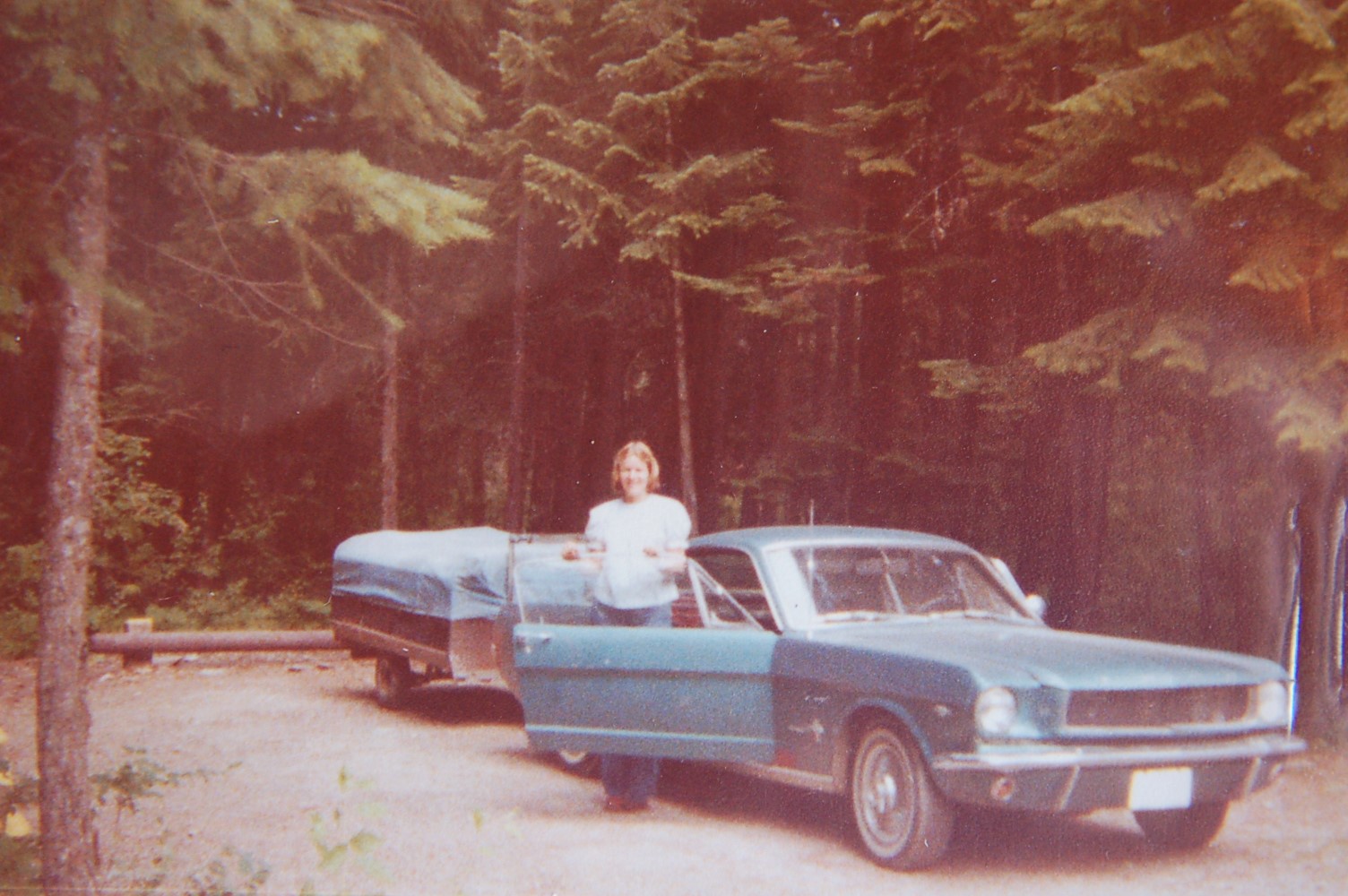
For shelter, we'll be towing behind the Ranchero a 1967 Montgomery Ward tent trailer. We are well acquainted with this little tent trailer. Linda and I purchased it in May 1977 from a family that lived next door to my college fraternity in Missoula, Montana. I learned later that the family acquired the tent trailer from my college swim coach, Fred Stetson. Fred bought it new from the Ward's catalog. I came across a copy of the 1967 Ward's catalog showing the tent trailer selling for less than $500.

1967 Montgomery Ward Spring and Summer Catalog
Linda and I purchased it for the princely sum of $175 in 1977. Even at that price we made installment payments and didn't take possession of the trailer until the price was paid in full. The canvas on the trailer was already well worn when we bought it. In the years following 1977 we would patch the canvas and nurse it along.  As I recall it drank nearly 2 gallons of canvas preservative. Inside, looking up at the top of the tent one would see a patchwork of mismatched canvas.

After our wedding, we went camping with the trailer at Sunset Beach State Park near Santa Cruz, California. It was one of many camping trips in the tent trailer. We continued to use it even after our 3 children were born.
Hayden Lake, Idaho 1978
Honeymoon near Santa Cruz, Ca.
1977

Craters of the Moon, Idaho 1992
3 Jolly Fishermen, Warm Lake, Idaho
1991


Linda and I slept on one side of the tent trailer. Before the children, the other side of the tent trailer was for storage for luggage and camping gear. As the kids came along they slept on the other side. Even when we had 3 we just laid them crosswise on the bed. It was cozy to say the least. By 1992 we were outgrowing the tent trailer. In addition to not having enough room for the whole family, there was no place to cook and eat during rainstorms. In 1993 I gave it to my brother, Kurt, and we bought a larger Coleman tent trailer.
Grand Teton N.P. 1992


When I began planning this trip I didn't envision camping our way to New York City. I thought I would stay in motels. When I finally voiced my plan to drive across country when I retired "I was a little surprised to hear Linda say: "That sounds like fun, let's do it together." Then she added : "But I don't like  sleeping in motels. I want to sleep in my own bed each night."

This came as a shock to me. When she said this we had been married around 35 years. I never knew that my wife did not like staying in motels. Linda then got to her point: "Let's  get a cute 1950's trailer  to tow behind the Ranchero."  She even showed me pictures of suitable candidates she found on the internet. Linda added: "I think its called 'Glamping'". Linda sounded positively enthusiastic, but I thought of the Lucille Ball and Desi Arnaz movie: "The Long Long Trailer".

So began the negotiations. As much as I like traveling I do not like towing large trailers. I didn't want a house trailer behind us obstructing vision and functioning as a giant "air dam". I didn't want to worry about what to do with it in cities and I didn't want to worry about backing up and turning around when we found ourselves in a tight spot. Most of all I didn't want to reduce fuel mileage on a car that was already a bit of a gas pig.

When I voiced these concerns Linda suggested another tent trailer. But the truth about most modern tent trailers is that they weigh nearly as much as a small house trailer. I was looking for something cheap and easy and that would provide us merely basic shelter. I'm also not convinced that all of the conveniences in larger more modern trailers are truly conveniences. They are often as not unnecessary complications which slow setting up or breaking camp.  I talked about our original tent trailer, the one we bought when we got married. Linda agreed to look at some. As we began to look at the tent trailers we recalled the trips in our first tent trailer. Nostalgia gripped both of us.

Unfortunately, there are very few of the simple old tent trailers left on the road. The one or two that we looked at that still had a serviceable tent were not convenient. The owners told us that we would really need to remove the tent from the trailer each morning before getting on the road. This was not my idea of convenience.

We longed for our old tent trailer. I asked my brother what happened to the old tent trailer that I had given him? He told me that he still had it and, without missing a beat, asked if I wanted it back? I said probably, but inasmuch as this was 20 years after I had given it to him I said that we would need to look at the tent trailer first.

In the 20 years that Kurt had the tent trailer he took amazingly good care of it. It was stored in his barn, and although dirty and dusty the canvas was still serviceable and even the many patches that Linda and I had sewn onto the tent were still in place and holding up well. I decided the trailer could be restored.

So began the tent trailer restoration.

Ready for Restoration, 2016
Although the canvas was serviceable we decided to replace it. We selected a lighter colored canvas as we remembered the trailer being dark inside. The new canvas is a big improvement, although with inflation it cost 7 or 8 times what we originally paid for the trailer. While the trailer was getting new canvas I also had a new road cover installed. The new road cover is meant to be more waterproof and secure than the one that originally came with the trailer.

New Tent (top)
stripping off the old paint (bottom)
After I received the trailer back from the upholstery shop my part of the job began. I removed the tent and frame from the trailer and began to inspect the parts. The first thing I noticed was that the rollers which support the beds had deteriorated and in some cases disintegrated. No problem I thought, but I was wrong. No one makes bed rollers for a 1967 Montgomery Ward Vacationeer tent trailer. Fortunately Workland machine shop in Boise was able to make new rollers from Teflon stock. The new rollers are better than the originals and finally a restoration cost that did not cost more than we paid for the entire trailer!

I then stripped the paint off of the body of the tent trailer after photographing all of the striping and decals on the trailer. My plan was to replicate the original striping. This proved to be just plain nuts. New decals cost me more than we paid for the tent trailer in 1977. They look great, and they are replicas of the original but I think I would be better off going to the auto parts store and purchasing some generic striping. One thing that is not original on the restored trailer is the color. Originally it was a brown color which Montgomery Ward described as "Chestnut". We decided that the trailer should be painted red with a white road cover to match the Ranchero.
As costly as this restoration was, I have to say that the two make a beautiful pair.... I wonder how many nights in a motel we could get for the same amount of money?

Ready for the road

Wednesday, February 15, 2017

(6) PREPARATIONS - the Car

Downtown Truckee Ca.
Summer 2009

The single most important piece of equipment in ensuring a successful road trip across the country is the car. We are driving a 1959 Ford Ranchero, which we purchased in 2007. Perhaps not the wisest choice to assure success. I didn't purchase the Ranchero for the purpose of driving across the country rather, I bought it because I wanted a first generation Ranchero. I greatly admire the 1957 and the 1959 Rancheros. (The 1958 looks like it was designed by a committee.)

1950s American automobiles get a bum rap. They are often mocked for the excessive chrome and tail fins. The 1959 Ford has tail fins, but they are restrained. And as for the chrome, I like it. It seems to me that our modern cars have gone to the other extreme, they have no style and all resemble jellybeans. No manufacturer has unique colors, and it is difficult to tell a Ford from a Toyota, or a Honda from a Chevy. Modern cars have all the style statement of a refrigerator. The Prius (or "Pius") most resembles the tape dispenser that sat on my office desk before I retired. I hated that tape dispenser.

Painting the Ranchero, Summer 2008
A beautiful but crowded Engine bay
This would  be a much easier trip if we drove one of our newer cars. I have never owned a new car,(and if the truth be told I have never even owned a current decade automobile) but, a newer car would have made this a worry free journey. It is not simply the age of the car that causes me worries it is the fact that the engine is really too big for the car's engine bay. I consistently have some problems with the car running hot in the summer.

I spent 10 years getting to know this car and I believe that the real cause of the problem is a 1950s engine bay stuffed with a more modern engine that would be more at home in full sized car of the 1960s or 1970's. The engine is a Ford big block, an FE which stands for Ford Edsel. The engine was first introduced in 1958 and was really a more modern than earlier engines of the 1950's. It is a great engine, used by the Ford Motor Company up to the late 1970s, perhaps even into the early 1980s. But my theory is that it is not at home in this old car. There is simply not enough space for air to circulate around the engine. High operating temperatures do not develop at highway speeds. Only around town is there cause for concern. I believe I have done everything possible to alleviate this problem, but it still nags me.

Linda has been a good sport about this Ranchero and about my automobile hobby in general. We bought the Ranchero in 2007 on the weekend of our 30th wedding anniversary. We spent the weekend in romantic Prineville Oregon, and the night at the City Center Motel which looks exactly the way it sounds. There is a memorable picture of us sitting on the tailgate of the Ranchero drinking champagne from Styrofoam cups in front of our motel room. I have done my best to make amends for my transgression.

30th Wedding Anniversary, Prineville Oregon
June 17, 2007
After purchasing the car in 2007, I first replaced the suspension. I then installed disc brakes because it's more important that a car be able to stop that it is for it to be able to go. After that I repainted the car and redid the interior. Over the past 15 months I have upgraded the engine with a modern fuel injection system, aluminum heads, and a new cam. Earlier I replaced the intake manifold with an aluminum intake. I have probably succeeded in reducing the weight of the car by 125 to 150 pounds.
Stripped down engine ready for upgrades
The fuel injection system and the engine are still getting to know one another. The Holley fuel injection system is a 21st-century system on a 59-year-old car. It senses the exhaust and makes changes in the fuel mixture on an ongoing basis. It's getting much better every drive, but to tell the truth I had really hoped for better economy. I took the advice of some of my car friends on the cam and I believe that they were probably more interested performance and less is interested in highway fuel economy than I am. I anticipate that pulling the trailer I will average between 14 to 15 miles to the gallon. I had hoped for 18.

New Cooling Fans
To address the cooling problem I  installed high capacity electric fans that assist with the airflow. The fans are only needed around town, but I believe that part of the airflow problem is also caused by the air being unable to exit the engine compartment. I will address this by "popping the hood" whenever we come to a town. Not a great solution, but at this late date it is all I can think of. I don't know if my proposed solution is correct, but I remember my father doing the same thing with our 1959 Ford Ranch Wagon with the same engine block. Ford hoods of the late 1950s hinged in the front and opened from the rear. This was considered a safety feature to prevent a hood from popping up on the highway and obstructing a driver's view. I will be popping the hood to try and extract some additional air from the engine compartment to cool the engine. I hope the theory proves correct. The hood will be latched down again as we get back on the highway.

The cooling issue also modified our proposed route. Originally I planned to start in the northwest and take the Yellowstone Trail east. However, we will take the Lincoln east in the early summer and do most of my driving in the morning to early afternoon. The northern tier should stay cooler late into June and this should help the cooling problems. Maybe a prayer or two will help as well.

A final project on the car was to civilize it a bit. The exhaust system was modified and quieter mufflers in stalled. Don't get me wrong, I loved the sound. It was what I would politely call a "don't mess with me sound." But even I would admit it was a 3 hour exhaust system. After 3 hours on the highway the drone of the exhaust began to eat at one's nerves. Linda would agree with all of this except the 3 hour part. She would probably describe it as a 30 minute exhaust system. Anyway, it is much quieter now.

I will see how this trip goes before I try again to do across country trip in a vintage car.

Under the old Reno Arch
Hot August Nights, August, 2010

Wednesday, February 1, 2017

(5) PREPARATION - Knowledge


A cure for insomnia!

As background for this trip I read everything I could find concerning the Lincoln Highway, the Yellowstone Trail and auto travel in general. Many of the sources were quite helpful, but a few did not contribute to my knowledge of the Lincoln Highway, the Yellowstone Trail nor to my preparation. Many of the sources I read were historical in nature, but several were contemporary. Most were about automobile travel, but some were not. Rinker Buck's book "The Oregon Trail" is neither about the Lincoln Highway, the Yellowstone Trail nor about automobiles. It was about his trek across the United States in a covered wagon. Nonetheless, the book is thought-provoking, well-written and a good lesson on being prepared for the journey ahead. One small book I read was Ford Motor Company's book "Station Wagon Living", a fun nostalgic read about camping in the late 1950's. It contributed a greatly to my enjoyment, but contained little of use to this journey.
Ford Motor Co Photo
From Station Wagon Living (1958)

Historical accounts give an appreciation of what early travelers endured on the Lincoln Highway and on the Yellowstone Trail. These early accounts remind us how easy we have it. Also I enjoy reading about the colorful personalities involved with both the Lincoln Highway and the Yellowstone Trail. Some of the early books list supplies to be taken along. Some items, such as a block and tackle, a slab of bacon and tire chains might have been useful 100 years ago but would be little help to me now for a 2017 summertime trip.

Brian Butko's books and travel guides on the Lincoln Highway are invaluable. Likewise Denny Gibson's book "By Mopar to the Golden Gate" was both enjoyable and helpful. Some of Denny's writings on the web and in particular advice he gave me on using a GPS to plan a trip will be of great assistance. Denny Gibson's book and Brian Butko's books deal with the Lincoln Highway. Most of the books I read, both historic and contemporary are about the Lincoln Highway. The Yellowstone Trail is not as widely known. Finding information concerning the Yellowstone Trail takes a bit more digging. While the information is not as widespread, what information exists is well researched and well written.

I was really only able to find three books of note concerning the Yellowstone Trail. The first book is Dorothy Dowling Prichard's book "We Blazed The Trail" about Michael Dowling's early trips on the Yellowstone Trail. Dowling was a remarkable man who nearly died in the great blizzard of 1880. He lost both feet and one hand to frostbite. Despite this he had a successful career in Minnesota state politics and was an advocate for the Yellowstone Trail. He traveled the Yellowstone from Minnesota to Yellowstone National Park and from Minnesota to Plymouth Rock in the very early days of the trail. The other 2 books I read were "Introducing the Yellowstone Trail" by John and Alice Ridge and "On the Road to Yellowstone" by Harold Meeks. These books describe how the Yellowstone Trail Association turned an apparent weakness into a strength which assured the Yellowstone Trail a place amongst the great coast-to-coast named highways of the early 20th century. The Association used its grassroots organization to successfully lobby county commissions and state road departments on a local level in a way that could not be done by a large national organization.

John Steinbeck's book "Travels with Charlie" reminded me of the importance of getting out of the car and talking to people. This may be hard for me at times, but it is something I hope to do. Linda will remind me.

Perhaps the best book on the history of highways in the United States is Earl Swift's: "The Big Roads." Likewise an article the June 1974 edition of American Heritage magazine by Joe McCarthy is a good source for historical material. One interesting thing about that article is it credits Carl Fisher with coming up with the name of the Lincoln Highway. More recent scholars credit Henry joy with coming up with the name. Whoever came up with the name, it's clearly a winner.
Having a background for this trip gives a deeper appreciation for the Lincoln Highway, it's founders and the individuals who first traveled it. The trip can be made without this knowledge but I don't think our sense of appreciation would be as great.

Ford Motor Company Photo


Sunday, January 15, 2017

(4) Why the Lincoln Highway and Yellowstone Trail?


Entrance to "The Old Lincoln Highway", Old Highway Drive, Donner lake Ca.


We did not start out this trip intending to drive east across the continent on the Lincoln Highway  returning west on the Yellowstone Trail. This trip began merely to fulfill a dream of driving across the United States. (Of course we would also need to return home after completing the trip east.) We decided fairly early on that we wanted to stick to US and State highways and avoid interstates wherever practicable. As the principal driver I did not want to drive the "mind numbing and sleep inducing Interstate Highways". ( Although I realize that a lot of two-lane roads can also prove to be mind numbing and sleep inducing.) In other words we are planning to stick to the so-called "blue highways".

About 10 years ago I began to focus my daydreams. Coincidentally also about 10 years ago I purchased a 1959 Ranchero and began a multiyear restoration. Naturally I began to toy with the idea of taking a road trip in the Ranchero. The restoration was performed with long distance travel in mind. The dream was taking root.

Linda plans most of our vacation, but this time she left it to me. In the early stages I didn't even share all of my dreams and aspirations for the trip with Linda. She always knew that I wanted us to drive across the country, perhaps even several times, but I don't think she realized how seriously I was taking it.

One of the first things to settle would be which route to take across country. I am nostalgic for US Route 40 because it travels through Donner Lake, California. However, in many areas route 40 has been buried by Interstate 80 and is badly segmented through much of the West. I then looked at US 50 which is pretty much a continuous US Highway from Maryland to California. I was determined that we would come home on US 50.

For the trip east my initial plan was to travel across the northern tier of the country. I considered US Route 2, US Route 12 US Route 20 and US Route 26. As I was planning things I discovered the Internet site: "Road Trip USA" which can be found at: https://roadtripusa.com/. As this was all happening in 2012, I noticed an article in the newspaper concerning the Centennial of the Lincoln Highway. The article changed everything. I may return to "Road Trip USA" for planning in the future, but for this trip it was now all about the Lincoln Highway.

Whitney Hotel, Advertisement
"We invite inspection"
Donner Summit
I had heard about the Lincoln Highway as a boy, but I was not aware of its significance. I don't ever recall the Lincoln Highway being mentioned when I was young without the words "The Old" preceding the words "Lincoln Highway". To me it was an old road that even as a boy was little more than a jeep trail or a hiking trail near our cabin at Donner Lake. I had no idea that it was the first transcontinental road. While I feel a little embarrassed over my ignorance, I think that I may have stumbled onto a secret on the Lincoln's enduring popularity. It is both local and transcontinental. It is grand and inspiring, yet intimate and personal. It truly was "America's Main Street."

In looking at a map of the Lincoln Highway it appeared that it hit most of the places that we  wanted to see. I soon found the Lincoln Hwy., Association's website: (https://lincolnhighwayassoc.org/) which, to my great joy, included an interactive map. The map details the Lincoln Highway and where it is no longer possible to follow the old road also includes modern detours.

As I began to research the Lincoln Highway I came across references to the Yellowstone Trail. As I began to research the Yellowstone, I found that it would cover many of the same roads that I had originally planned to travel east when I was still looking at theRoad Trip USA and using it as my planning tool. Recently the Yellowstone Trail Association (http://www.yellowstonetrail.org/) has also upgraded its website and includes extensive maps which are easy to use for planning and navigation.
As I began to immerse myself in the history of both of these old roads I became more and more intrigued. Linda, my family and many of my friends would say I became obsessed. I don't think it was that bad, but I won't argue very hard.

The Lincoln Highway will take us east to Times Square. The plan is to then drive north to Plymouth Massachusetts where the Yellowstone Trail commences west. It will be harder to follow the Yellowstone Trail than it is to follow the Lincoln. I will not be taking the car and trailer off of the pavement for either the trip east on the Lincoln or the trip west on the Yellowstone and many parts of the Yellowstone Trail are unpaved.

Planning this trip may be an obsession, but it is turned into a delightful obsession as it has combined my love of history with my love for cars and camping and road trips. I think I've died and gone to heaven!


Bronze Boundary Marker at California-Nevada
border, Dog Valley Route.

(3) A Thumbnail History of American Highways

Carl Fisher, Founder Lincoln Highway
Chicago History Museum, Chicago Daily News
Deutches Haus (Athenaeum)
Indianapollis, Indiana
Birthplace of the Lincoln Highway
We enjoyed a delicious lunch at the Rathskeller, November 2016
 To understand the importance and significance of the Lincoln Highway and the Yellowstone Trail to America it is necessary to step back and to view the America of 1910. At that time there simply were no roads connecting the vast expanse of the United States. What roads existed, existed only in cities. When roads reached the city limits they simply disappeared or deteriorated to dust or sticky mud.

Travel between the East Coast and the West Coast was only by rail. Not only were there no roads, but there were no roadmaps or guides or directional signs that could be used by a motorist, or "autoist" as they were known then. The joke of the city slicker asking directions of a farmer on how to get to a certain town and being told: "You can't get there from here" was no joke. The grim reality was that it was a statement of fact. What roads might have existed outside the city limits went nowhere. They were simply unconnected spiderwebs radiating from towns or rail centers.

In Emily Post's 1916 book "By Motor to the Golden Gate" she recounts a story of asking the best route from New York to San Francisco. She was told the best route was "The Union Pacific". When Emily asked a woman experienced in travel across the country about driving a motorcar to the west coast, she was told that it couldn't be done. In fact while Emily successfully navigated from New York to San Francisco she spent very little time on the Lincoln Highway. Upon leaving New York City she traveled north and then west to Chicago. When she did travel on the Lincoln, she described it as being a vast sea of mud.

It's easy to get romantic about the named highways. Certainly it sounds more adventurous to talk about journeying on the Lincoln Highway or the Yellowstone Trail than it does to drive on Interstate 80 or even US 40, but the Lincoln and the Yellowstone had their shortcomings. They relied upon voluntary contributions from Association members, benefactors, corporate sponsors and cities and counties along the route in order to complete the transcontinental roads. This worked, but was not a permanent solution and even the founders of the Lincoln Highway and the Yellowstone Trail felt that
state and federal governments would have to step in.

Individuals and private organizations in fact stepped in to fill the breach before the creation of state highway departments and the federal Department of Transportation. While the Lincoln Highway Association and the Yellowstone Trail Association were alike in that they were private associations they were each unique from one another. The Lincoln Highway Association had the backing of most of America's automobile manufacturers as well as the companies which supplied the products used in the manufacture of roads and automobiles.

The Yellowstone Trail Association had little such support. It was more of a grassroots movement made up of farmers and businessmen of the towns lying along the Yellowstone Trail, more rural in approach. If the county assessed a road tax for the construction of a segment of the Yellowstone Trail, a citizen might just satisfy the obligation of that tax by contributing work on a designated workday. The problem with this was that real work was hard to come by. There are jokes about WPA workers resting on their shovels during the Great Depression 20 years later, but they had nothing on the disorganized workforces that at times turned out for a day of roadbuilding in 1913 or 1914. Oh the job got done, but after the initial enthusiasm less of the job would get done.

There is really nothing like these highway associations today. They coordinated road construction, acted as boosters for towns and tourist destinations along their route. They acted much like the AAA or oil companies which distributed maps and provided travel advice and they advocated for good roads and published best practices for road construction. The Lincoln Highway Association even funded demonstration projects, a practice followed up by the modern federal department of transportation. Unfortunately the named highways became victims of their own shortcomings as well as their own success and by the mid-1920s certain transportation corridors became confusing jumbles of competing signs and routes. This left telephone poles crowded with signs and motorist confused.


"Pole Markers" for the Transcontinental named Highways.

The creation of named highway associations and the work that they did were really the quintessential American response to getting the job done. If government was not going to step in, private citizens would step up. The named highway movement occupied only a brief time in our history. The US highways and subsequent interstate highways ultimately proved to be a much better response to America's transportation needs, but they built upon a foundation laid by the named highway associations. I can't help but get romantic when thinking about two-lane travel and the individuals behind the Lincoln Highway and the Yellowstone Trail. Great credit needs to go to the founders of these two American roads who got the ball rolling.

President Lincoln Highway Assoc.

J.W.Parmley Founder Yellowstone Trail Assoc.

1st Director Fed. Hwy Admin.
Fed. Hwy. Admin. Photo
The end of the line for named Highways


(2) What to call this ramble about a ramble...

Ready for the Road

I struggled with the title for this journal. I had quite a few ideas rolling around in my head (there's a lot of empty space up there) but I wanted to find something that would be catchy, that I didn't have to explain (too much) and that would entice the reader, arouse curiosity, and provide an idea of what this journal was all about.

One of the books I read in preparing for this trip was: "The Family Flivvers to Frisco", a 1927 account of a family's transcontinental trip on the Lincoln Highway written by Frederic van de Water. I enjoyed the humorous presentation of the book and thought about calling this journal "A Flivver Flees from Frisco", but even though the car we will be driving is an old Ford I don't think of it as a "flivver" and I was worried that if I used that title I would have to explain just what a flivver is and, perhaps worse, the rest of the title might be interpreted as making some sort of political statement about the city of my birth. My other problem with that proposal was with the word "Frisco" which was an obscenity in the house I  grew up in. Mom wouldn't allow it and would scold any of my friends who dared utter the offensive word. Catchy or not, respect for Mom and a risk of confusion wouldn't allow that title.

After considering and rejecting several possibilities, my friend, Dave Frazier suggested: "A Ford on the Lincoln" which is a catchy title, should only take a minimal amount of explanation and avoids misleading people into thinking that this is some sort of a political tract.

Although I considered the suggestion to be very good, I still was not sold. My problem with the title was and is that it shortchanges the Yellowstone Trail which is also a significant transcontinental road of the early 20th century and on which we will be spending nearly 50% of our time. This second concern explains the subtitle: "A Honeymooning couple's adventures on the Lincoln Highway and Yellowstone Trail".

Although Linda and I will celebrate our 40th wedding anniversary on this trip, I believe that we are still a honeymooning couple. I hope the honeymoon will continue even after a summer on the road together.


Linda on one of our early camping adventures


(1) Introduction

My first visit to Donner Lake
June 1956

I have always wanted to drive across country. That simple desire is the origin of this cross country trip. Perhaps part of this desire grew out of a sense of envy. I envied my brothers who went camping with my dad shortly after I was born. They had the opportunity to see and to remember seeing many sights throughout the far west. My wife, with her family, spent an entire summer "touring the states". Even our three children, Charlie, Lorelei and Will have each driven across country.

When I was young my parents purchased a cabin at Donner Lake, California. I think that my brothers envy the summers my sister and I spent at the lake. Don't get me wrong, I had a wonderful time those summers at Donner. Summers that I would not trade for anything. But when I look at photo albums and see my brothers camping with Dad, or realize that they can remember later camping trips that are merely a dim and foggy recollection to me, I'm jealous.

Looking back I can see that I've spent much of my adult life trying to make up for the travel and camping trips that I perceive I missed. It is my very good fortune to have a wife that shares my wanderlust and my love of "car camping". When Linda and I married in 1977 we purchased a 10-year-old tent trailer for the princely sum of $175.00. We used it extensively on vacations and on long weekends. We camped with it until the early 1990s when our family outgrew it. We then bought another used tent trailer. Vacations were often spent showing the kids the national parks and traveling throughout the Western United States. Over the years I think that we were able to see and to share with our children all of the National Parks west of the Dakotas and north of Texas. But I still haven't traveled across country and I intend to do it. This series of journal entries is about the trip that Linda and I will make across America in the summer of 2017.

Another thing I can see in retrospect is that we envy the experiences of others which we may have missed. I think it's healthier to look at experiences as trade-offs. If I had experienced travel and camping as a child I would've had to forgo other experiences. I have to say that I've enjoyed my life immensely. I'm not sure what I would trade for my brothers' experience. I guess it's better to simply do it now. I will now make sure that I do it right.

I realize that not everything I write down will be of interest to every reader. I've provided historical background to give context.  That may bore those not interested in transportation history, while at the same time infuriating those who find my descriptions nothing more than gross oversimplifications. Sections of this journal dealing with the preparation of the car and trailer may prove tedious to non mechanics and those not interested in automotive or camp trailer restoration, but should we make it across country the preparations are as important as the drive. If you are bored with a section, for gosh sakes skip it!

As I write this I realize that I'm making a prediction concerning the future. The future does not always go as planned. Perhaps we will not camp as much as we hope to this summer. Perhaps the road will be too much for our 59 year old car. We may spend a few nights in motels if Midwestern rains and storms make it impractical to set up camp. I guess we will take the road as we find it and trust to providence.


A Ford on the Lincoln
Summer 2009