Tuesday, July 11, 2017

(47) Homeward!


July 10, 2017
Mobridge, South Dakota to Billings, Montana


Railroad Bridge crossing the Missouri


Earlier  Bridge at the time of the Yellowstone Trail
This morning we crossed the Missouri River at Mobridge, South Dakota. It was a bright clear morning and I took a picture of both the automobile bridge that we were crossing as well as the old railroad bridge. After crossing the Missouri we found ourselves once again in the arid West. We spent the remainder of the day traversing South Dakota, North Dakota and much of Montana.

Automobile Bridge over the Missouri

Missouri Bridges


North Dakota


In North Dakota, we found miles and miles of miles and miles. Our last stop in North Dakota was Marmarth.


The unusual name comes from the fact that the railroad engineer was naming it after his daughter, Margaret Martha. Apparently Margaret Martha would not work as a name of the town so it was shortened to Marmarth. Marmarth has the oldest motion picture theater in all of North Dakota. I believe it is still operating, although much of the rest of the town is not.


Mystic Theatre in Marmarth, North Dakota

At the western edge of the town of Marmarth is the Van Horn automobile Museum. Jim Van Horn has assembled quite a collection of beautifully restored vehicles. In addition to automobiles, Jim collects whatever suits his fancy. At the end of the tour we were treated to an ice cream. It was delicious.
Ford GP prepared for review by Army


Jim Van Horn and part of his collection


Montana

We then proceeded into Montana. At the western edge of North Dakota and the eastern edge of Montana we found ourselves in the Badlands. The scenery was not quite as spectacular as that in Badlands national Park, but we appreciated it nonetheless, I'm glad that we don't live there.

Montana Badlands


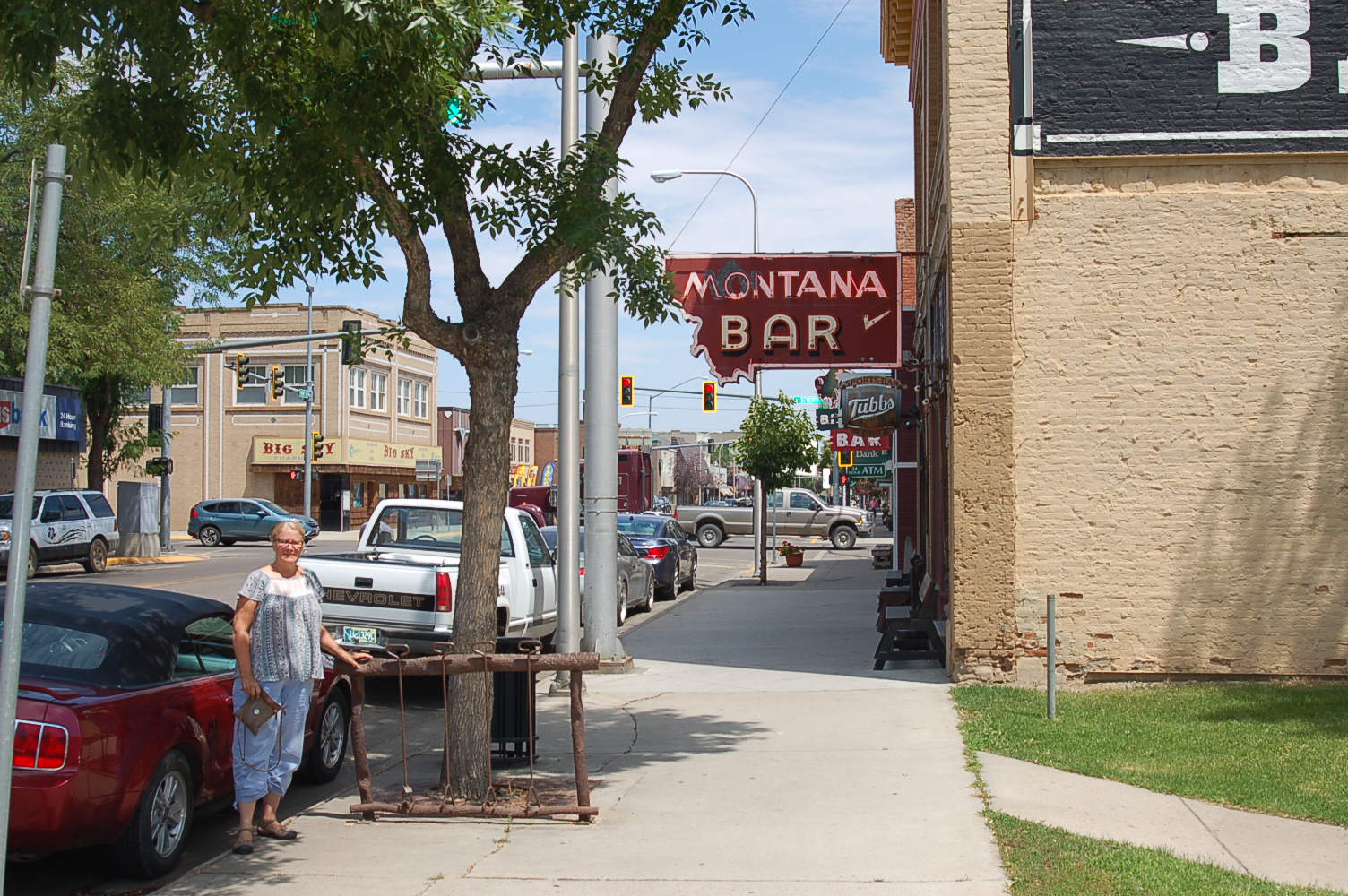
Montana Bar, Miles City, Montana
Main Street, Miles City Montana

We stopped in Miles City Montana to have lunch at the Montana Bar. My last visit to the Montana Bar was in May, 1974. I went to Miles city with two friends from college who told me that if I wanted to experience Montana culture at its finest I needed to attend The Bucking Horse Sale which is held in May of each year in Miles City.

Bucking Horse Sale, May, 1974
My friends told me that we would probably end up drinking too much and might find ourselves in a couple of fights. To a 19-year-old college freshman this sounded like something I needed to experience. I did end up drinking a bit too much, but managed to avoid the fights.

Bar in the Montana Club
One of the bars I visited in May, 1974 was the Montana Bar. I well remember going to the Bucking Horse Sale. The Bucking Horse Sale is where all the saddle broncs come from for the rodeo circuit. It is basically a big rodeo with horse buyers then bidding on the broncs.

I have fond memories of the Bucking Horse Sale. I remember that Saturday night in May, 1974 that the Montana Bar was very crowded and very noisy. It was difficult to get from one end of the barroom to the other. It was a bit quieter today and today there were actually barstools in front of the bar. No trip to Miles City is complete without a visit to the Montana Bar.

I had a steak sandwich and I felt like they were staring at me.
The walls are decorated with mounts representing the cream of the cattle drives. There is also a bullet hole in a beveled glass window as you walk in the bar. How that window survived, I don't know. The bullet hole was the result of an accidental discharge that occurred when a patron was checking his gun. But it all makes for great fun and a colorful afternoon or evening.

Bullet hole in glass panel
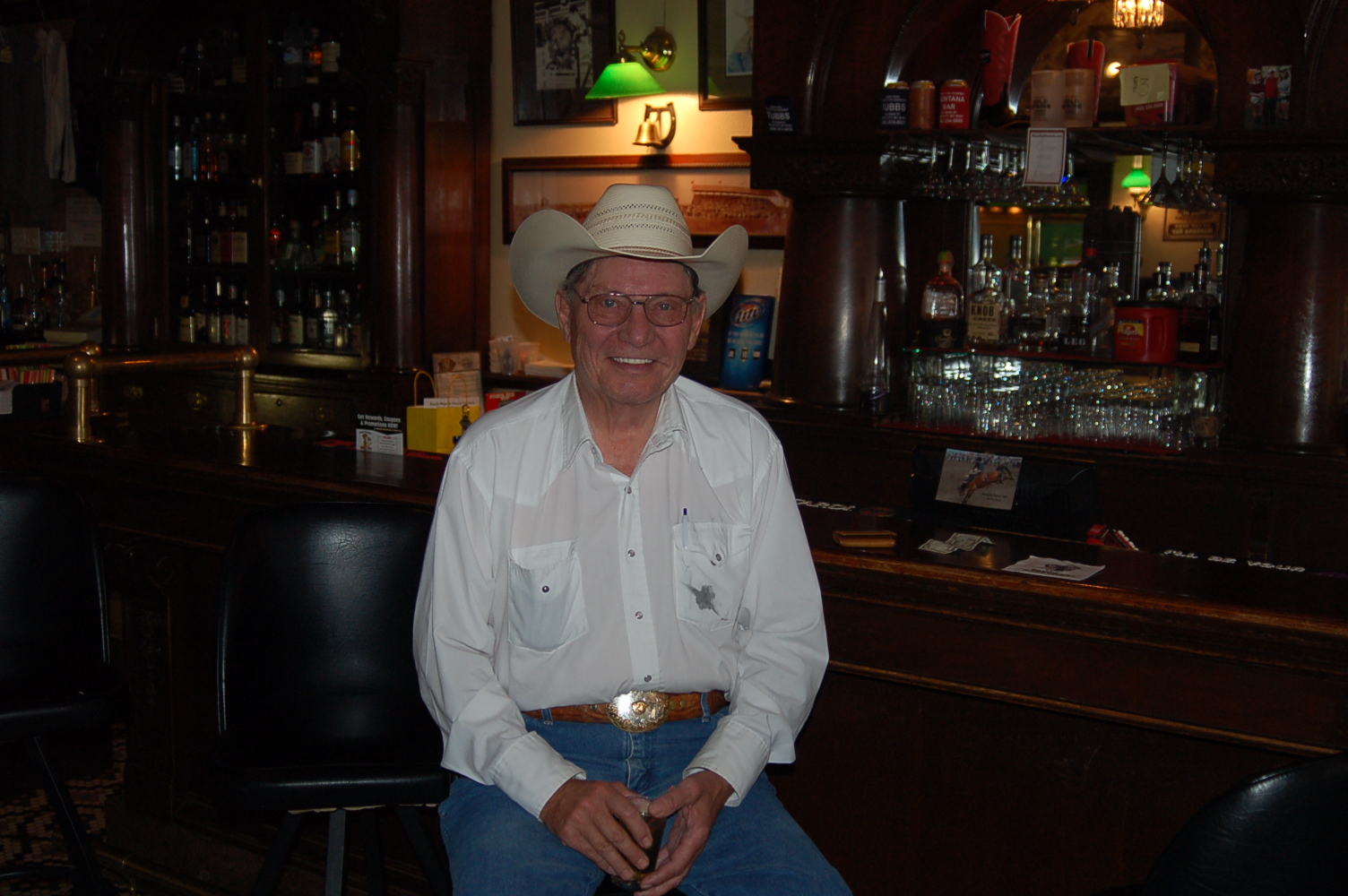
While we were at the Montana Club, I struck up a conversation with Charlie who had spent most of his professional life as a cattle broker. Charlie told me that the Montana Club was a good place to do business. The booths had high walls and it was like being in a soundproof room.

Charlie, a Cattle broker from Miles City
Forsyth Montana to Billings


Thankfully, the road was better than this.

Split Rock, near Big Horn Montana
On the Yellowstone Trail


After Miles city we traveled to Forsyth, Montana and then on to Pompey's Pillar.

Pompey's Pillar along the Yellowstone River
Pompey is the nickname that William Clark gave to the son of Sacagawea. His full name is Jean Baptist Charbonneau. He was born in 1805 and died in 1861. Little Pompey was the youngest member of the Corps of Discovery. He had a front row seat to the making of history through much of the nineteenth century. William Clark saw to it that he got a good education. He died in the second half of the nineteenth century near Jordan Valley, Oregon. Earlier this year, I visited his grave and I'm happy to report that many people visit the grave and leave tributes to little Pompey.

Pompey's Grave near Jordan Valley, Oregon

After Pompey's Pillar we traveled west to Billings. We will spend the night in Billings before moving on to Livingston and Yellowstone National Park. We have debated on where to end this trip. At one time we had planned to go all the way to Puget Sound. However, the need to retrieve our car in California has made that original goal impractical. We decided to end the trip where the Yellowstone Trail originally ended. That is, Yellowstone National Park.


Monday, July 10, 2017

(46) Nobody ever told the bumblebee it couldn't fly!


Ipswich, Birthplace of the Yellowstone Trail


July 7, 2017
Lac qui Parle State Park, Minnesota
to Mobridge, South Dakota

We are spending tonight in Mobridge South Dakota on the banks of the Missouri River. Mobridge is so named because there is a bridge over the Missouri River at this point. The abbreviation for Missouri is Mo. Combine that abbreviation with the word bridge and the town at that point ends up with the name Mobridge.

Once again we "gave in" and are not spending the night in the tent trailer. It is 105° here and sleeping in our canvas tent trailer did not sound pleasant. I guess we're getting old.

We started the day battling mosquitoes at the campground in Minnesota. Minnesota is known for its mosquitoes, although the state's Department of Commerce does not promote that fact. The mosquitoes made us to break camp at Lac qui Parle State Park in Montevideo (pronounced "Mount video") quickly and gave us a few parting bites on the way out of the campground just to make sure that we would remember the place.

Ortonville, Minnesota
The first town we visited was Ortonville, Minnesota. Ortonville is the county seat for Big Stone County Minnesota. It is another Midwestern city that has been passed by, by the march of time. It appears that it was once fairly prosperous. It still looks pretty good, but there are a few vacant storefronts on Main Street.

The reason we traveled to Ortonville and went through the city is that I have an antique postcard of the Big Stone County Courthouse. The Big Stone County Courthouse was built in the first decade of the 20th century. Since it was only a block out of our way, I was curious to see if the courthouse was still standing and how it had weathered the passage of time. It was still standing proud and is being maintained by the county in good repair. Big Stone County, it seems, is proud of its courthouse.


While we were in Ortonville we stopped for breakfast at the Ligonberry coffee shop. A ligonberry is a Scandinavian berrry that is somewhat tart, but makes into a very good jam to be spread on muffins.

The coffee shop was owned by Khadija who operates it along with her sister Karina. Most of the pastries are prepared on site, although a few are purchased from outside vendors (yummy chocolate croissant).  Khadija was born in Ortonville, but left and has seen the world. She returned home to open the Ligonberry coffee shop. As much as we enjoyed our time there, we needed to get on the road and keep moving west.
Khadija and her sister Karina
War Memorial on Courthouse grounds
From Ortonville we immediately crossed into South Dakota. While we had seen some Yellowstone Trail signs in Minnesota and Wisconsin, we began to see more and more in South Dakota. South Dakota is the birthplace of the Yellowstone Trail, but more on that later.

The first town that we came to in South Dakota was Milbank. Milbank is home to the Milbank mutual insurance company and is also the birthplace of the Super 8 motel chain.


At a park across the street from Milbank Mutual's headquarters there is a windmill. It turns out that this windmill was a gristmill when the town of Milbank was first settled. As the town grew with houses and other commercial structures going up, along with the planting of trees to line the city streets, the owner the gristmill found that it affected the wind. The wind power had to be supplemented in order to grind wheat into flour.

Eventually, operating the gristmill became uneconomical and it was suffering from neglect. Some public spirited citizens, recognizing the importance of the gristmill to the town's history purchased it and moved it. Later it was restored and moved once again. The Milbank Mutual Insurance Company takes good care of the windmill. From what I read they maintain it for the city, its citizens and visitors to enjoy.

Competing claims are just part of the fun!
Prairie Pothole Country

We moved on from Milbank to Ipswich, South Dakota. On our way to Ipswich we passed through the Prairie Pothole Country. The Prairie Pothole Country is a remnant of the last Ice Age. As the ice receded from the northern Great Plains, it left a relatively flat countryside, but not one that is perfectly flat. As the ice sheet receded, it left potholes as well as moraine. In the spring as the snow melts and with spring rains, these potholes fill with water. Some are so large and deep that they are also fed by springs and remain a standing body of water for the entire year. Most of the potholes dry up during the year. Farmers and cities have eliminated most of the potholes, but those that remain are now guarded as productive wetlands which are the breeding grounds for most of the waterfowl in this country.

These Prairie Potholes proved to be an immense challenge to the railroad engineers and to the road builders of the early 20th century.

Ipswich South Dakota and the birth of the Yellowstone Trail

Vintage scene of Ipswich. It doesn't
look so different today.


 Ipswich is the birthplace of the Yellowstone Trail. Joseph Parmley was a lawyer and owned a land office in Ipswich. Parmley was a product of the late nineteenth and early twentieth century.

Parmley was urged to run for Congress
He was caught up in the progressive movement. He joined the prohibition movement and his wife was a member of the Women's Christian Temperance Union. Parmley was also active in the reclamation movement, which turned the West into productive farmland. But most of all, Parmley is remembered for his advocacy and hard work in the "Good Roads Movement".

Gathering of Good Roads Advocates outside of Parmley Land Office
Parmley sought to make his city, his state, and the region a better place to live. He was a strong advocate of the Good Roads Movement. Initially Parmley sought a road from Ipswich, east, to Aberdeen, South Dakota. It is from this seed, that the Yellowstone Trail grew. Very soon Parmley and others envisioned a road all the way from Minneapolis, Minnesota to Yellowstone National Park. The goal was later expanded to include Chicago, Illinois to Yellowstone. That eventually grew to include the goal of "A Good Road from Plymouth Rock to Puget Sound."

Tire Cover from the car Joe Parmley drove to
promote the Yellowstone Trail
One wonders how Parmley and others from South Dakota ever thought they could build a road from Plymouth Rock to Puget Sound? What is even more amazing is that they did it. They did it in a manner different from the way that the Lincoln Highway accomplished its goal, and if the truth be told, the road probably was not quite as good, but they did it nonetheless. The story reminds me of
the movie I once saw where a character in the movie said that aerodynamically there was no way that a bumblebee should fly. He then added that nobody told the bumblebee that, and so the bumblebee flies. I guess nobody ever told Parmley and the other businessmen and farmers from South Dakota and Minnesota that they could not build a transcontinental road.

A Sign on the Ipswich Memorial Arch

Parmley is held in high esteem in South Dakota and particularly in Ipswich. He was a remarkable man.
Livingroom fireplace made of stones and shells collected by Parmley
Parmley was known to be a very good public speaker. As I noted before he believed in prohibition, at least initially. Before the Prohibition Amendment to the Constitution was ever passed prohibition foes are suspected of setting fire to Parmley's house. Parmley built another house which was also burned down. The next house he built was built of concrete, brick and stone. Even the floors on the first and second floor, and the stairs are concrete. Today, Linda and I toured that house. It will last another 100 years.
Parmley's  house built of brick, stone and concrete.
It won't burn down.

Joe Parmley, by his hearth.


I wish Joe were here so we could talk.
Joe Parmley was really a remarkable fellow. While I know he wouldn't join me for a drink, I would like to sit down and have a long chat with him. What he and others from South Dakota and Minnesota accomplished, even without the resources and public relations know how of the Lincoln Highway Association is really quite amazing.

Tom is a volunteer docent at the Parmley house and Museum.


Tom, a volunteer docent at the Parmley
museum, in front of the Parmley Land office
For him it is a labor of love. He led Linda and I on a very informative tour of the house and then a tour of Joe Parmley's land office. We felt bad that we had to keep moving on as Tom had much more information to share with us.  For someone like me, I am very grateful for people like Tom, who desire to keep these local museums going for the next generation. Many times this is where the history lies.

Today is a day I will long remember.

Joe Parmley, outside his land Office

Sunday, July 9, 2017

(45) Michael Dowling, A Most Inspiring Figure


Michael Dowling, a most Inspiring Man

July 8, 2017
Marshfield, Wisconsin to Montevideo, Minnesota

This morning was the third morning that we awoke in a motel. We have had some difficulty finding suitable campsites, and the weather does not always cooperate. Yesterday, for instance, we had planned to camp but at approximately 3 o'clock in the afternoon the heavens opened up. We were heading west on the Yellowstone Trail through Wisconsin and had to slow to about 35 miles an hour because of the heavy rain. Many other drivers simply pulled off the road and waited for the rain to subside. Perhaps I should've done so as well, but I was concerned about somebody from behind running into me.

After seeing how wet the rain had made things we decided to get a motel room. The funny thing was when we arrived in Marshfield, Wisconsin not only had the rain stopped, but the sky was clear and things were dried out. Oh well, the motel bed was nice and soft.

Wisconsin Farm
This morning we woke up and left Marshfield driving west towards Altoona, Wisconsin. Very soon, we found ourselves in the Dairyland that we had expected from the time we entered Wisconsin. The dairy farms were neat and orderly.

Back in Amish Country
We also found ourselves back in Amish country. We slow down several times for horse and buggies that shared the road with us.

Amish Traffic Jam
When we reached Altoona we spent a couple of pleasant hours with John and Alice Ridge.

John and Alice Ridge
John is the president of the Yellowstone Trail organization. He and Alice devote countless hours towards mapping the Yellowstone Trail and providing detailed information both on the website and in response to any and all questions. The maps on the Yellowstone Trail website are second to none. They are both detailed and easy to follow.

John and Alice just returned from a trip west to verify Yellowstone Trail alignments. Unfortunately the records of the Yellowstone Trail are not complete when it comes to highway alignments. John has gone out into the field and used his knowledge of the trail and his observations to provide more detailed records and maps. For John, being close is simply not good enough. John is a retired math professor and for him the answer is either correct or incorrect. I marvel at the knowledge that both he and Alice have of the Yellowstone Trail and other old highways. I'm also grateful for their hard work and determination.

Coffee and Kringle
After we talked old highways, we had the opportunity to socialize a bit over coffee and Kringle. Kringle is a delicate pastry that is filled with butter, brown sugar, and nuts. It is delicious with coffee.

After coffee we said goodbye to John and Alice and continued west on the Yellowstone Trail. We drove from Altoona to the Minnesota state line. We decided not to drive through Minneapolis, but instead skirted it on Interstate 494.

Norwood Minnesota

After escaping the Minneapolis Metropolitan region we rejoined the Yellowstone Trail, driving through Waconia, Glencoe, Olivia, Granite Falls and are spending the night at Lac qui Parle State Park where they raise voracious mosquitoes. The state park was overpriced and inadequate. The electrical hook up did not work. The mosquitoes, however, were working overtime and harassed us all night!

Michael Dowling

Dowling's Bank in Olivia, Minnesota
Dowling writing with only a thumb to hold his pen,
We stopped in the town of Olivia to take a look at the building that housed the bank owned by Michael Dowling. One of the things that I enjoy about studying old highways is the personalities behind the highways. Dowling was truly an inspirational and exceptional figure. During the blizzard of 1880 Dowling was riding on the back of a wagon and was bounced off the wagon and into a snow bank. The blizzard was such that the driver of the wagon could not hear Dowling's cries for help. Dowling stumbled around in the below zero temperatures before seeking shelter in a haystack. In the morning he found that his limbs were frozen. Two legs, one arm and four fingers on his remaining hand and arm were amputated. Despite this Dowling went on to be a successful figure in Minnesota politics, he was a successful businessman and he "blazed the Yellowstone Trail West to Yellowstone National Park and East to Plymouth Rock."


He was an inspirational speaker and told World War I amputees not to mourn on what they had lost but the focus on what they had. Dowling often said to friends: "Thank God I'm not a cripple"
We are camping tonight west of Olivia, and I can't help but think of Michael Dowling and what he accomplished and what he overcame.